When SparkToro published their 2024 research showing 61% of Google searches end without a click, the SEO industry had two reactions: disbelief and acceptance. The disbelievers wanted to dispute the methodology. The acceptors recognized what they had already been seeing in their own Google Search Console data for two years.
The more important question is not whether the number is accurate — it is. The important question is what is causing it. Because understanding the mechanisms means you can identify which of your keywords are at risk, quantify the traffic you're losing to each mechanism, and build a strategy that accounts for the new reality.
Mechanism 1: Google AI Overviews (Largest Impact)
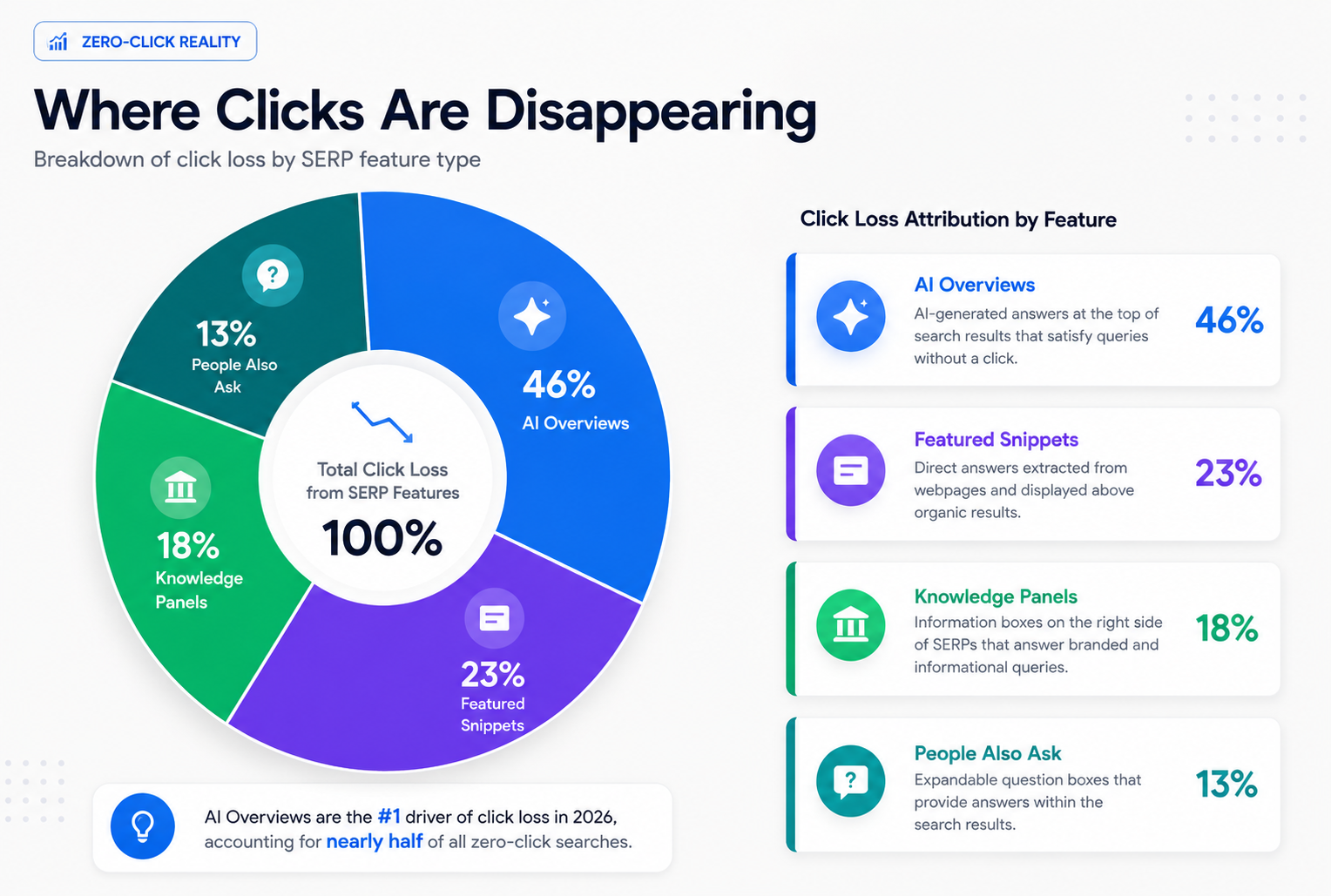
Google AI Overviews are the single biggest contributor to click loss in 2024-2026. They appear at the very top of search results pages for approximately 47% of all queries and typically occupy the entire above-the-fold viewing area on desktop and mobile. A user reading an AI Overview has no reason to scroll down to organic results — their question has been answered.
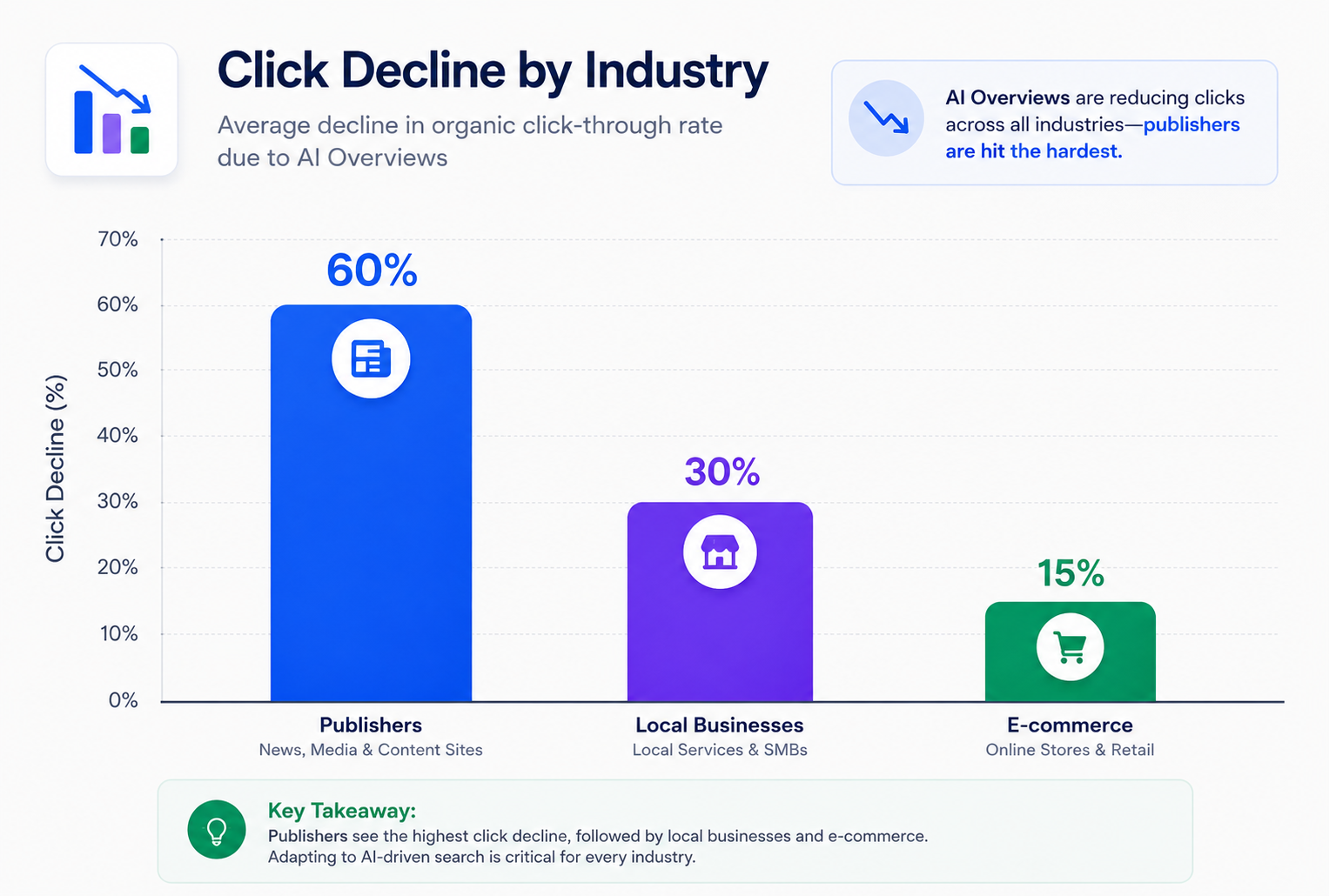
Research from multiple SEO platforms including Semrush and Ahrefs shows that AI Overviews reduce organic CTR by an average of 34% for queries where they appear. For high-volume informational queries where AI Overviews are almost universal, the aggregate traffic impact is enormous.
Mechanism 2: Featured Snippets (The Original Click Thief)
Before AI Overviews, featured snippets were the primary driver of zero-click behavior. A featured snippet pulls a specific answer from a webpage and displays it in a prominent box at position zero — above all organic results. Counterintuitively, the page that provides the snippet often receives less traffic than it would if it simply ranked in position 1 without a snippet, because users get their answer from the box without clicking through.
Featured snippets appear in roughly 12% of all Google searches. Research shows they reduce the position 1 organic CTR by 8.6 percentage points on average per query — meaning a keyword that would drive 20% CTR without a snippet drives only 11.4% with one.
Mechanism 3: Knowledge Panels (Branded Search Impact)
Knowledge panels provide instant structured information about businesses, people, books, movies, and other entities. For branded searches — users searching your business name — knowledge panels appear in 43% of cases and often provide enough information (address, phone, hours, ratings) that the user's need is met without a website visit. This is particularly damaging because branded searches typically have the highest intent and conversion potential.
Mechanism 4: People Also Ask (The Click Loop Trap)
People Also Ask (PAA) boxes appear in over 40% of Google searches and create what researchers call the "PAA loop" — each expanded PAA question generates more PAA questions, keeping users engaged with the SERP rather than clicking to any website. For informational queries with multiple related sub-questions, PAA can single-handedly answer an entire research session without a single click.
The Business Impact by Query Type
The impact of these mechanisms varies significantly by query intent. Purely informational queries ("what is," "how does," "why is") have zero-click rates exceeding 70%. Navigational queries (brand names, website names) retain high CTR because the user's intent is to reach a specific site. Transactional queries ("buy," "book," "hire") have 20-30% zero-click rates — lower but not zero. Commercial investigation queries ("best X for Y") are increasingly captured by AI comparison summaries, pushing their zero-click rate up from 15% in 2022 to 35% in 2026.
Understanding where your keyword portfolio falls across these intent categories is the first step to quantifying your actual zero-click risk exposure — and building a content strategy that accounts for the new landscape.