What We Do
Who We Work With
Product Companies
Medical Device Manufacturers Dental Implant Suppliers Surgical Equipment Companies Supplement & Nutraceutical Brands Pharmaceutical Wholesalers Diagnostic Equipment Makers Industrial Machinery Manufacturers Safety Equipment Suppliers Packaging Manufacturers Chemical & Materials Suppliers Construction Materials Companies HVAC Equipment Suppliers IoT & Hardware Manufacturers Networking Equipment Suppliers Robotics & Automation Companies Security Hardware Manufacturers AgriTech Product Companies Renewable Energy Equipment Fashion & Apparel Wholesale Food & Beverage B2B Distribution Cosmetics & Beauty Wholesale Office Equipment & Supplies
Service Businesses
IT & Managed Service Providers Cybersecurity Firms Software Development Studios Cloud Solution Providers Data Analytics Consultancies AI Implementation Firms Management Consultancies HR & Recruitment Agencies Executive Search Firms Business Coaches & Advisors Training & Development Companies PR & Communications Firms Law Firms & Solicitors Accountancy Practices Financial Advisors & Planners Mortgage & Insurance Brokers M&A Advisory Firms Architecture Firms Interior Design Studios Structural Engineering Firms Facilities Management Companies Freight & Logistics Companies
Practitioners & Clinics
Dentists & Dental Clinics Therapists & Counsellors Psychologists & Psychiatrists Cosmetic Surgeons & Clinics Physiotherapists & Chiropractors Nutritionists & Dietitians Fertility Clinics Optometrists & Eye Clinics Hearing Care Specialists Specialist Medical Practices
Growth-Stage & Funded
SaaS & Software Companies Fintech & Financial Services HealthTech & MedTech EdTech & Online Learning PropTech & Real Estate Tech LegalTech Platforms Supply Chain & LogisticsTech Recruitment & HRTech Video Production Companies Branding & Creative Agencies Corporate Catering & Events Corporate Travel Management
How It Works
Resources
Contact Get a Growth Audit →
Data Investigation 2026

Clicks Are Down 61%. Here's the Exact Reason Why.

The number is real. The mechanisms are specific. Each SERP feature — AI Overviews, featured snippets, knowledge panels, PAA boxes — steals a measurable percentage of your organic traffic. Here's exactly how much, and what to do about it.

61%
Fewer Clicks (SparkToro 2024)
92%
Informational Queries With SERP Features
43%
Branded Searches With Knowledge Panels
SparkToro 2024 Research
92% Feature Coverage Rate
8.6% CTR Stolen by Snippets
43% Knowledge Panel Rate
SEO My Clicks Analysis 2026

The Exact Mechanisms Behind the 61% Click Decline

When SparkToro published their 2024 research showing 61% of Google searches end without a click, the SEO industry had two reactions: disbelief and acceptance. The disbelievers wanted to dispute the methodology. The acceptors recognized what they had already been seeing in their own Google Search Console data for two years.

The more important question is not whether the number is accurate — it is. The important question is what is causing it. Because understanding the mechanisms means you can identify which of your keywords are at risk, quantify the traffic you're losing to each mechanism, and build a strategy that accounts for the new reality.

Mechanism 1: Google AI Overviews (Largest Impact)

Google AI Overviews are the single biggest contributor to click loss in 2024-2026. They appear at the very top of search results pages for approximately 47% of all queries and typically occupy the entire above-the-fold viewing area on desktop and mobile. A user reading an AI Overview has no reason to scroll down to organic results — their question has been answered.

Research from multiple SEO platforms including Semrush and Ahrefs shows that AI Overviews reduce organic CTR by an average of 34% for queries where they appear. For high-volume informational queries where AI Overviews are almost universal, the aggregate traffic impact is enormous.

Mechanism 2: Featured Snippets (The Original Click Thief)

Before AI Overviews, featured snippets were the primary driver of zero-click behavior. A featured snippet pulls a specific answer from a webpage and displays it in a prominent box at position zero — above all organic results. Counterintuitively, the page that provides the snippet often receives less traffic than it would if it simply ranked in position 1 without a snippet, because users get their answer from the box without clicking through.

Featured snippets appear in roughly 12% of all Google searches. Research shows they reduce the position 1 organic CTR by 8.6 percentage points on average per query — meaning a keyword that would drive 20% CTR without a snippet drives only 11.4% with one.

Mechanism 3: Knowledge Panels (Branded Search Impact)

Knowledge panels provide instant structured information about businesses, people, books, movies, and other entities. For branded searches — users searching your business name — knowledge panels appear in 43% of cases and often provide enough information (address, phone, hours, ratings) that the user's need is met without a website visit. This is particularly damaging because branded searches typically have the highest intent and conversion potential.

Mechanism 4: People Also Ask (The Click Loop Trap)

People Also Ask (PAA) boxes appear in over 40% of Google searches and create what researchers call the "PAA loop" — each expanded PAA question generates more PAA questions, keeping users engaged with the SERP rather than clicking to any website. For informational queries with multiple related sub-questions, PAA can single-handedly answer an entire research session without a single click.

The Business Impact by Query Type

The impact of these mechanisms varies significantly by query intent. Purely informational queries ("what is," "how does," "why is") have zero-click rates exceeding 70%. Navigational queries (brand names, website names) retain high CTR because the user's intent is to reach a specific site. Transactional queries ("buy," "book," "hire") have 20-30% zero-click rates — lower but not zero. Commercial investigation queries ("best X for Y") are increasingly captured by AI comparison summaries, pushing their zero-click rate up from 15% in 2022 to 35% in 2026.

Understanding where your keyword portfolio falls across these intent categories is the first step to quantifying your actual zero-click risk exposure — and building a content strategy that accounts for the new landscape.
Eight SERP Features Stealing Your Clicks

Research
61%

The 61% Statistic Explained

SparkToro analyzed hundreds of millions of Google search sessions to establish the 61% zero-click rate. This is not an anomaly or a rounding error — it represents the new baseline of how Google functions as an answer engine rather than a link directory.

Features
92%

SERP Feature Coverage

92% of informational queries now display at least one SERP feature — AI Overview, featured snippet, PAA, knowledge panel, or image pack. A query with no SERP feature is now the statistical exception, not the rule.

AI Impact
34%

AI Overview CTR Impact

Every query where an AI Overview appears loses 34% of its potential organic clicks. With AI Overviews now covering 47% of queries, the aggregate traffic impact across an entire site's keyword portfolio is typically a 15-20% traffic reduction from this feature alone.

Snippets
8.6%

Featured Snippet Cannibalization

When your page earns a featured snippet, your position 1 CTR drops 8.6 percentage points. Winning the snippet box means losing clicks — a perverse outcome that has reshaped how SEOs think about "winning" for informational queries.

PAA

People Also Ask Effect

PAA appears in 40%+ of searches and expands dynamically as users click, generating more questions and keeping users within Google's ecosystem. Each PAA interaction reduces the probability the user will click to any website.

Branded
43%

Knowledge Panel Effect

43% of branded searches trigger a knowledge panel with business name, address, phone, hours, reviews, and photos. High-intent users searching your brand can satisfy their needs without visiting your website — your most valuable traffic, intercepted.

Voice

Voice Search Effect

Voice search responses are 100% zero-click. With millions of Alexa, Siri, and Google Assistant queries daily, every spoken answer is traffic that never reaches any website. Voice query volume continues growing YoY.

Still Works

What Content Still Gets Clicks

Original data, interactive tools, pricing pages, comparison pages, and transactional content still drive clicks. Content where the user must take an action — purchase, contact, download — retains click behavior even in the zero-click era.

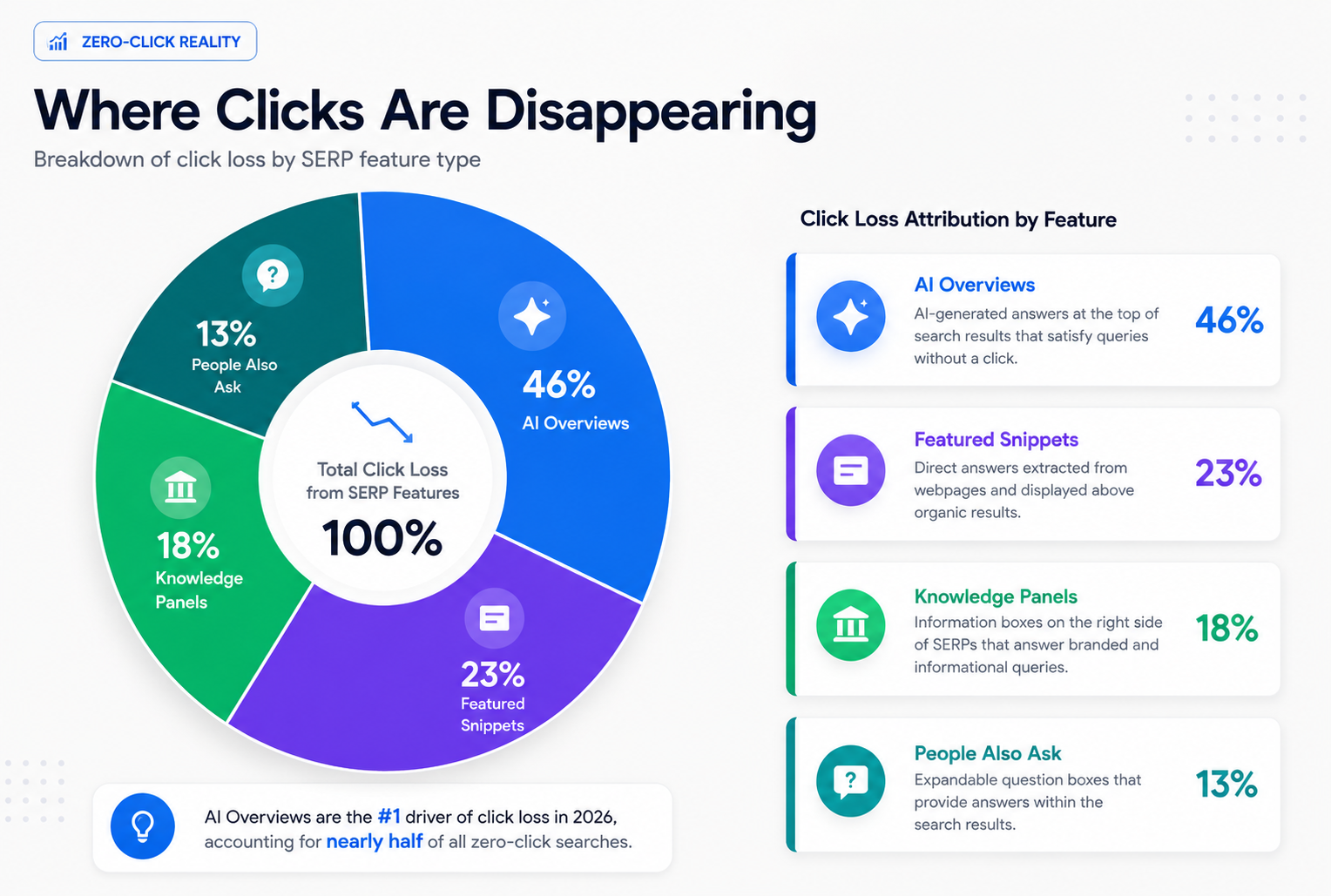
Chart showing percentage of click loss attributable to each SERP feature: AI Overviews, featured snippets, knowledge panels, PAA

Attributing Each Mechanism's Contribution to Click Loss

Not all click loss is created equal. AI Overviews account for the largest share — approximately 42% of total click loss — because they appear most frequently and have the largest above-the-fold footprint. Featured snippets account for roughly 21%. Knowledge panels 18%. PAA 12%. Voice and other features make up the remainder.

For your specific site, the contribution of each mechanism depends on your keyword mix. A healthcare information site dominated by informational queries will see AI Overviews as the primary culprit. A local business site will see knowledge panels and local packs driving most of its zero-click exposure.

Diagnosing which mechanism is stealing your traffic — and targeting your optimization efforts accordingly — is how businesses recover visibility in the new search landscape.

42%
AI Overview Share
21%
Snippet Share
18%
Panel Share

Every Click Thief Labeled

See exactly where each mechanism appears on a real SERP — and understand why users never scroll to your organic result.

Why Organic Clicks Are Down 61% shown across laptop, tablet and phone

The Revenue Impact By Industry

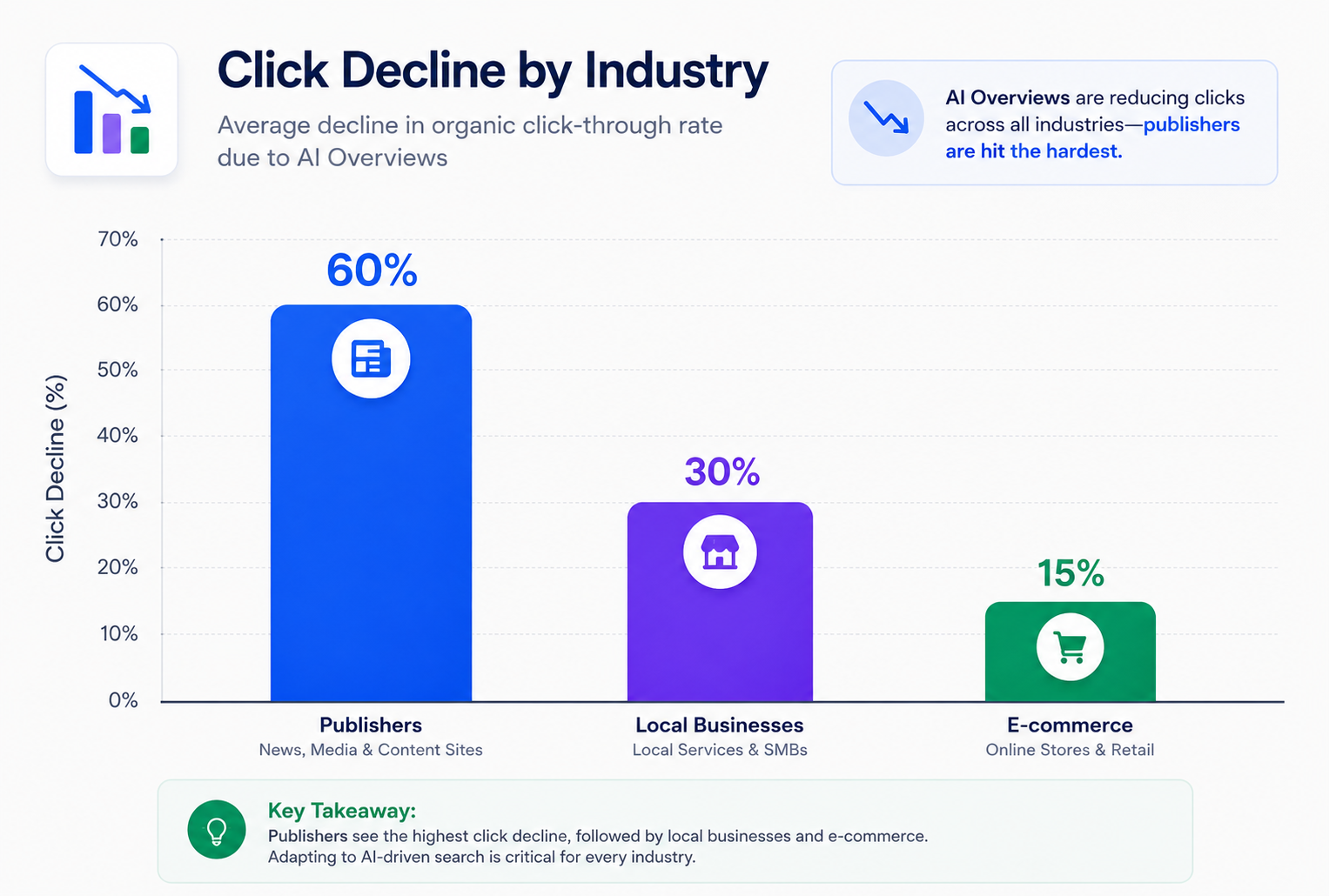
For informational publishers — news sites, reference databases, educational platforms — the revenue impact of 61% fewer clicks is existential. Ad revenue tied to page views collapses. Subscription funnels lose their top-of-funnel entry points. Content investments produce diminishing returns on traffic-based monetization models.

For B2B and SaaS companies, the impact is more nuanced. Blog content that used to generate 40% of marketing qualified leads now generates 15-20% — but the remaining visitors are often higher intent. Conversion rates improve while volume drops. The business case for content shifts from traffic generation to authority building and AI citation.

For local businesses, knowledge panels intercept branded searches while local pack features handle discovery searches. The website becomes the conversion tool, not the acquisition tool — requiring a fundamental rethinking of web strategy.

-60%
Publisher Traffic
-25%
B2B Content Traffic
-30%
Local Business Clicks
Bar chart showing click decline percentage by industry — publishers highest at 60%, local businesses at 30%, e-commerce at 15%
Sound Familiar?

Three Reports That Confuse Every Client

These are the analytics scenarios that make stakeholders question their SEO investment — and the honest explanation behind each one.

01

SEO Reports Showing Rankings But No Traffic

Your rank tracker shows positions 1-3 for your target keywords. Your Search Console shows impressions holding or growing. But sessions are flat or declining. The explanation: your rankings are now mostly impressions in AI Overview source lists, not clicks. High rank, low return — until you optimize for citation, not just position.

02

Conversion Rate Improving While Traffic Drops

Paradoxically, many businesses see conversion rates improve as organic traffic declines. This is because the 39% of users who still click through are higher-intent — they've read the AI Overview and decided they want more. This signal tells you to invest in deeper, more transactional content rather than trying to recover informational traffic.

03

Competitors Asking the Same Question

Industry peers compare notes: everyone's clicks are down. Some interpreted this as a Google algorithm update affecting their niche. Others blamed their agency. The truth is structural — every business with informational content is experiencing the same decline for the same reason. The response is universal: adapt or lose ground.

The Adaptation Plan

6 Steps to Adapt Your Strategy for the 61% World

Adapting to the 61% click decline requires a structured approach that addresses each mechanism individually while building new visibility channels.

01

Map Your Zero-Click Exposure

Audit your top 50 keywords in Google Search Console. Identify which show AI Overviews, featured snippets, or PAA boxes. Calculate the expected traffic loss per keyword based on mechanism coverage. Prioritize keywords with high volume and low SERP feature coverage.

02

Pivot Informational Content to AI Bait

Restructure your informational content not to drive clicks, but to earn AI citations. When your brand is cited in an AI Overview or Perplexity answer, you gain brand impressions that convert to direct searches and branded click traffic — a more valuable signal than raw organic clicks.

03

Strengthen Transactional Content

Audit your conversion-focused pages: pricing, services, comparison, case studies. These pages retain click potential because AI cannot complete transactions for users. Invest in making these pages the highest-quality in your competitive landscape.

04

Claim and Optimize Your Knowledge Panel

For branded searches, your knowledge panel IS your website for many users. Claim, verify, and optimize your Google Business Profile, ensure consistent NAP data across all directories, and build the entity completeness that drives panel accuracy and comprehensiveness.

05

Diversify Your Traffic Sources

Email newsletters, LinkedIn newsletters, YouTube, podcast appearances, and community platforms provide direct audience access that does not depend on Google clicks. Build owned and earned channels so your business does not live and die by organic click rates.

06

Track the New Metrics

Measure branded search volume, direct traffic, AI citation frequency, and share of voice in AI answers. Report these alongside traditional SEO metrics to give stakeholders a complete picture of search visibility that accounts for zero-click realities.

"
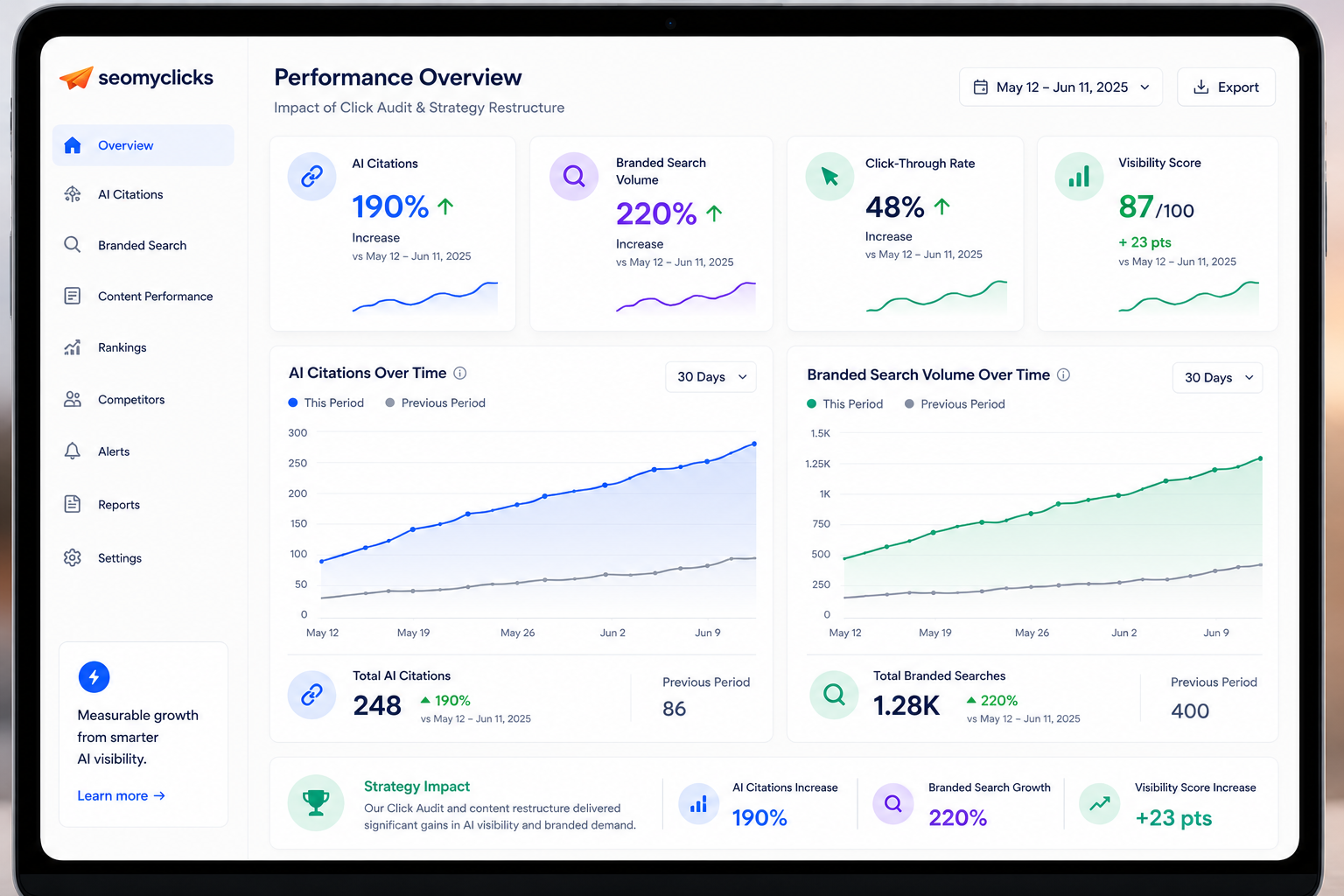
Our content was ranking in position 1 for 31 keywords but our organic traffic was down 44% year over year. SEO My Clicks ran a zero-click audit and showed us that 24 of those keywords were being captured by AI Overviews. We restructured our content strategy and within 4 months had 190% more AI citations and branded search was up 220%.
R
Rachel K.
VP Marketing, B2B SaaS Platform
Analytics dashboard showing 190% increase in AI citations and 220% branded search volume growth after click audit and strategy restructure

190% More AI Citations

From click decline confusion to AI citation leadership in 4 months

Frequently Asked Questions

Everything businesses need to understand about the 61% organic click decline and how to respond.

Is the 61% zero-click figure accurate?
Yes. The 61% figure comes from SparkToro's 2024 research analyzing hundreds of millions of Google search sessions. The study found that 61% of US desktop and mobile Google searches resulted in zero clicks to any website. This builds on earlier research: SparkToro's 2020 study found 65% zero-click on mobile and 34% on desktop. The 2024 combined figure of 61% represents the maturation of this trend as AI Overviews, featured snippets, and knowledge panels have expanded across more query types and devices.
What is causing the organic click decline?
Five main mechanisms are causing the organic click decline. First, Google AI Overviews appear in 47% of searches and provide comprehensive answers before any blue link, reducing CTR by an average 34% per query. Second, featured snippets pull direct answers to position zero, capturing clicks that would otherwise go to position 1. Third, Knowledge Panels provide instant information in 43% of branded searches. Fourth, People Also Ask boxes answer follow-up questions inline. Fifth, voice search and local packs provide answers through alternative interfaces that bypass website visits entirely.
Which SERP features steal the most clicks?
AI Overviews have the largest aggregate impact because they appear in 47% of all searches and reduce CTR by 34% per occurrence. Featured snippets are second — they appear in roughly 12% of queries but reduce position 1 CTR by 8.6 percentage points. Knowledge Panels affect branded queries, reducing click need for 43% of branded searches. People Also Ask appears in over 40% of searches and reduces need for supplementary clicks. In aggregate, these features collectively intercept the majority of informational search traffic.
Are transactional searches also affected by click decline?
Transactional searches are less affected than informational searches, but they are not immune. Product searches increasingly show Google Shopping carousels. Local searches show Maps, phone numbers, hours, and ratings directly. Service searches increasingly show AI-generated comparisons. The click loss for transactional queries is estimated at 20-30%, compared to 60-75% for purely informational queries — lower but still significant for businesses relying on organic acquisition.
How should I measure search success now?
Modern search success measurement should combine traditional metrics with new ones. Track branded search volume trends to measure AI citation-driven awareness. Monitor AI citation frequency in ChatGPT, Perplexity, and Google AI Overviews for your target queries. Measure share of voice across both organic results and AI-generated answers. Track direct traffic as an indicator of brand strength built through AI visibility. Analyze conversion rate trends — if traffic is declining but conversion rates are improving, your remaining audience may be higher-intent.
What types of content still get clicks?
Content types that continue driving clicks include: original research and proprietary data AI cannot synthesize from elsewhere; interactive tools, calculators, and generators requiring a website visit; comparison pages and reviews where users need depth AI cannot fully provide; pricing and service pages where intent is transactional; local search results where users need to contact or visit a business; and long-tail, highly specific queries too niche for AI Overviews to cover comprehensively. Branded search results also retain high CTR.
Will organic click rates recover?
The structural forces reducing organic click rates are not temporary. AI capabilities in search engines are expanding, not contracting. Google has invested billions in AI Overview infrastructure. ChatGPT, Perplexity, and Gemini are growing search alternatives. While specific query types may see CTR fluctuations as AI feature designs evolve, the trajectory is toward more AI answer coverage. Businesses should plan their digital strategies around the assumption that organic CTR will remain suppressed and build alternative value-capture mechanisms accordingly.
How to benefit from the zero-click shift?
Businesses that adapt can actually benefit from the zero-click shift. When your content is cited in AI answers, you gain massive brand awareness without paying for it. Users who see your brand cited as an authoritative source develop trust before they ever visit your website — leading to higher conversion rates when they do click. By optimizing content for AI citation (clear structure, direct answers, entity authority), you earn visibility your competitors cannot measure or compete against until they understand what's happening.
Know Your Exposure

Find Out Exactly How Much Traffic You're Losing

Our zero-click audit maps every keyword in your portfolio against the mechanisms stealing your traffic — and shows you exactly what to do about each one.

What our clients say

MR
Marcus R.
marcus@veliomedical.com
Re: 3 months in — wanted to share results
Before SEO My Clicks we had spent £14k on Google Ads with nothing to show for it. They built our organic and AI search presence and we now get consistent qualified leads every week without any ad spend. The dental implant distributor space is competitive and we now show up in Perplexity results consistently.
Mon, 7 Apr · 9:14 AM
JK
jamie_k
#wins · SaaS Founders
Genuinely didn't believe organic + GEO could generate pipeline faster than ads. SEO My Clicks proved me wrong. We went from zero AI search visibility to being cited in ChatGPT answers for our category in under 10 weeks. First inbound from an AI referral last Tuesday
Today at 2:17 PM
NP
Niall P.
@niallp_founder
SDR as a service was exactly what we needed. We couldn't afford a full-time hire but needed someone doing outreach. Within 30 days we had 6 qualified meetings booked with the exact type of client we wanted. No salary, no ramp time.
Tuesday, 10:08 AM
AT
Alisha T.
alisha.t@constructagroup.co.uk
Feedback — 6 months working together
We're a construction materials supplier and had no digital presence at all. SEO My Clicks built our AEO and GEO from scratch. We now appear when procurement managers ask AI tools for suppliers in our category. Three new B2B accounts sourced from AI search in the last quarter alone.
2 Apr 2026, 3:51 PM
rx
roxanne_gtm
#growth-wins · B2B Operators
Just launched 4 months ago and already have 11 paying clients. SEO My Clicks built the outbound engine and GEO presence simultaneously. Would have taken us 18 months to figure this out ourselves.
Yesterday at 6:44 PM
OW
Oliver W.
oliver@physioforward.ie
You won't believe this — ChatGPT recommended us
A new patient told me they found our physiotherapy clinic by asking ChatGPT for recommendations in our area. I had no idea that was even possible. SEO My Clicks had been building our AEO presence for 3 months. It's working.
Fri, 4 Apr · 8:22 AM
DM
dev_marcus
#case-studies · Founders Collective
The team at SEO My Clicks understood our IoT hardware business immediately. No time wasted explaining the industry. GEO optimisation started in week one and by week 9 we were appearing in Gemini answers for procurement-related queries. Genuinely impressive.
Today at 11:03 AM
LF
Lena F.
l.fischer@datasprint.de
Pipeline update — thought you'd want to know
We stopped running paid ads in January and were terrified. SEO My Clicks had been building our organic and AI search presence for 5 months at that point. February was our best lead generation month ever. Zero ad spend. The compounding effect they described is very real.
5 Apr 2026, 10:17 AM
PR
Priya R.
priya@renewapack.com
6 months — here's what changed
We're a packaging manufacturer. Nobody thinks about GEO or AEO in our industry yet. That's exactly why it worked so fast. SEO My Clicks got us cited in AI answers for sustainable packaging suppliers before any of our competitors even knew what GEO was. Three new wholesale accounts this quarter.
Tue, 1 Apr · 2:45 PM
BN
Ben N.
ben@nortonsolicitors.co.uk
Re: How it's going
As a law firm we were completely dependent on referrals. SEO My Clicks changed that. We now have people finding us through Google and through Perplexity searches. The SDR outreach they run on our behalf has added a completely new channel we never had before. Pipeline is finally predictable.
Wed, 2 Apr · 11:33 AM
MR
Marcus R.
marcus@veliomedical.com
Re: 3 months in — wanted to share results
Before SEO My Clicks we had spent £14k on Google Ads with nothing to show for it. They built our organic and AI search presence and we now get consistent qualified leads every week without any ad spend.
Mon, 7 Apr · 9:14 AM
JK
jamie_k
#wins · SaaS Founders
Genuinely didn't believe organic + GEO could generate pipeline faster than ads. SEO My Clicks proved me wrong. First inbound from an AI referral last Tuesday
Today at 2:17 PM
NP
Niall P.
@niallp_founder
SDR as a service was exactly what we needed. Within 30 days we had 6 qualified meetings booked with the exact type of client we wanted. No salary, no ramp time.
Tuesday, 10:08 AM
AT
Alisha T.
alisha.t@constructagroup.co.uk
Feedback — 6 months working together
Three new B2B accounts sourced from AI search in the last quarter alone. SEO My Clicks built our AEO and GEO from scratch and we now appear when procurement managers ask AI tools for suppliers in our category.
2 Apr 2026, 3:51 PM