What We Do
Who We Work With
Product Companies
Medical Device Manufacturers Dental Implant Suppliers Surgical Equipment Companies Supplement & Nutraceutical Brands Pharmaceutical Wholesalers Diagnostic Equipment Makers Industrial Machinery Manufacturers Safety Equipment Suppliers Packaging Manufacturers Chemical & Materials Suppliers Construction Materials Companies HVAC Equipment Suppliers IoT & Hardware Manufacturers Networking Equipment Suppliers Robotics & Automation Companies Security Hardware Manufacturers AgriTech Product Companies Renewable Energy Equipment Fashion & Apparel Wholesale Food & Beverage B2B Distribution Cosmetics & Beauty Wholesale Office Equipment & Supplies
Service Businesses
IT & Managed Service Providers Cybersecurity Firms Software Development Studios Cloud Solution Providers Data Analytics Consultancies AI Implementation Firms Management Consultancies HR & Recruitment Agencies Executive Search Firms Business Coaches & Advisors Training & Development Companies PR & Communications Firms Law Firms & Solicitors Accountancy Practices Financial Advisors & Planners Mortgage & Insurance Brokers M&A Advisory Firms Architecture Firms Interior Design Studios Structural Engineering Firms Facilities Management Companies Freight & Logistics Companies
Practitioners & Clinics
Dentists & Dental Clinics Therapists & Counsellors Psychologists & Psychiatrists Cosmetic Surgeons & Clinics Physiotherapists & Chiropractors Nutritionists & Dietitians Fertility Clinics Optometrists & Eye Clinics Hearing Care Specialists Specialist Medical Practices
Growth-Stage & Funded
SaaS & Software Companies Fintech & Financial Services HealthTech & MedTech EdTech & Online Learning PropTech & Real Estate Tech LegalTech Platforms Supply Chain & LogisticsTech Recruitment & HRTech Video Production Companies Branding & Creative Agencies Corporate Catering & Events Corporate Travel Management
How It Works
Resources
Contact Get a Growth Audit →
Reference Guide

The AI Search Glossary

40+ essential terms from GEO to zero-click search, defined clearly for business owners, marketers, and growth teams navigating the AI search landscape in 2026.

At a Glance
40+
Terms Defined
Q2 2026
Last Updated
180+
Teams Using This
Generative Engine Optimization
Answer Engine Optimization
AI Overviews
Entity Authority
Zero-Click Search

Why Understanding AI Search Terminology Matters

The Language Gap Costs You Results

The language of AI search is new and evolving rapidly. Businesses that understand the correct terminology outperform those that don't by 4x in AI visibility — not because vocabulary is magic, but because precise language enables precise strategy. A team that confuses GEO with SEO runs the wrong campaigns. A team that conflates AEO with content marketing produces content that never wins AI citations. Shared vocabulary is the prerequisite for aligned execution.

Agency Briefing and Internal Alignment

When you brief an agency using the correct terminology — GEO not SEO, citation signals not ranking factors, entity authority not domain authority — you get back the right work. When internal teams align on shared definitions, strategy discussions move faster, budget decisions become clearer, and performance reviews measure what actually matters. This glossary exists to eliminate the miscommunication that wastes months and budgets.

Definitions Based on Observed Behaviour

The terms in this glossary are defined based on observed AI engine behaviour and citation pattern research across 94 client engagements — not vendor marketing copy or theoretical frameworks. Where AI engine documentation is unclear or contradictory, definitions reflect what the data shows actually affects citation rates. Where the industry has conflicting definitions for a term (common in a field this new), we use the most precise and useful interpretation.

A Living Reference Updated Each Quarter

AI search is evolving faster than any previous search technology. New platforms launch, existing platforms change their retrieval and citation behaviour, and new concepts emerge from research. This glossary follows the 13-week freshness protocol — it is reviewed and updated every quarter to reflect current AI engine behaviour. The last update was June 2026. If you spot a term that is outdated or missing, contact growth@seomyclicks.com.

The Six Most Important Terms to Know

Core Concept

GEO — Generative Engine Optimization

The practice of optimizing web content so AI engines like ChatGPT, Perplexity, Gemini, and Google AI Overviews cite your brand when generating answers. Different from SEO in four fundamental dimensions: signals (citation signals vs ranking signals), content format (extractable answers vs keyword-optimized text), measurement (AI citation frequency vs search ranking position), and timeline (first citations in 6–10 weeks vs SEO taking 4–12 months).

  • Target: AI citation, not search ranking
  • Key signals: extractability, entity authority, freshness, structured data
  • Measurement: AI Visibility Score (0–100), citation frequency/week
  • Timeline: first citations in 6–10 weeks of optimization
AEO

Answer Engine Optimization

Optimizing for the selected answer position in any answer-presenting system — featured snippets, AI Overviews, voice search, and conversational AI. Focuses on winning the answer slot rather than a ranking position. Requires question-intent matching, direct answer structure, and FAQ schema.

Authority

Entity Authority

The degree to which AI engines recognize and trust a brand as an authoritative source. Built through Google Business Profile, LinkedIn, G2, Crunchbase, Wikipedia, consistent NAP data, and third-party mentions. A foundational GEO requirement — without it, even well-structured content may not be cited.

Stat

Zero-Click Search

61%

of Google searches now end without a click. Users get their answer from AI Overviews, featured snippets, or Knowledge Panels. This is the primary driver for GEO — if most users never reach blue links, brands must appear in the AI answer itself.

Signal

Content Extractability

How easily an AI engine can pull a clean, direct answer from your page. High-extractability content leads with the answer in sentence 1, uses question-format H2 headings, bulleted lists for multi-item content, and avoids burying answers in long prose. The single highest-impact GEO change for most pages.

Technical

RAG — Retrieval-Augmented Generation

The process AI engines use to retrieve relevant web content and synthesize it into a generated answer with citations. Understanding RAG explains why GEO works: optimize for retrieval (SEO signals) AND extraction (content structure + schema). Both steps must pass for a citation to occur.

The Complete A–Z Glossary

Score yourself — check off the terms your team already knows, and use the gaps to identify where vocabulary alignment is needed.

A
AEO — Answer Engine Optimization
The practice of structuring content to be selected as the definitive answer in voice search, featured snippets, Google AI Overviews, and conversational AI responses. AEO focuses on question-intent matching, direct answer structure, and FAQ schema implementation. It targets "position zero" in both traditional and AI search environments. Related to GEO but broader — AEO covers all answer systems while GEO specifically targets generative AI citation.
AI Overview
Google's AI-generated summary appearing at the top of search results for approximately 47% of queries. Powered by Gemini, it synthesises multiple sources into a paragraph-form answer and cites 3–5 sources. Appearing in AI Overviews requires both strong SEO performance and GEO content optimization — specifically high extractability, FAQPage schema, and Speakable schema pointing to key answer sections.
AI Search
An umbrella term for search systems that use large language models to generate answers rather than returning lists of links. Major AI search systems include ChatGPT Search, Perplexity AI, Google AI Overviews, Gemini, and Bing Copilot. AI search is growing 300% year-over-year and now handles queries that users previously directed to Google's traditional blue-link results.
AI Visibility Score
A composite metric (0–100) measuring how prominently a brand appears across the four major AI search platforms. Calculated by auditing citation frequency across ChatGPT, Perplexity, Google AI Overviews, and Gemini for a defined set of category queries. The average AI Visibility Score for B2B brands is 12/100. Brands achieving 40+ see 4× more total citations than brands scoring below 20.
Author Entity
A named individual recognised by AI engines and search systems as having verifiable expertise in a specific domain. Author entities with established online presence (LinkedIn profile, published articles, credentials, institutional affiliations) provide an E-E-A-T trust signal that increases content citation likelihood. All editorial content optimized for AI citation should have a named, verifiable author with a full bio.
B
Brand Entity
A business or organisation recognised in AI engine training data and knowledge graphs as a distinct, trustworthy entity in a specific industry or topic domain. Building brand entity recognition — through consistent cross-platform presence, Knowledge Graph entry, and third-party corroboration — is a core GEO strategy that improves citation rates across all AI platforms simultaneously.
Branded Search
A search query that includes a brand name (e.g., "SEO My Clicks review"). Branded search volume is a key proxy metric for GEO success — brands cited in AI answers see 200–340% more branded searches as users search for the brand name they encountered in an AI response. Google Search Console data showing branded search growth is one of the clearest measurable signals that AI visibility is working.
C
Citation Signal
A factor that AI engines evaluate when deciding whether to cite a piece of content in a generated answer. Primary citation signals: content extractability (can the AI pull a clean answer?), entity authority (is the source recognised as trustworthy?), freshness (how recently was it published or updated?), cross-platform corroboration (do other authoritative sources agree?), and structured data (is FAQPage, Speakable, or Article schema implemented?). Strong signals across all five dimensions maximise citation probability.
Content Extractability
The ease with which an AI engine can identify, parse, and extract a clean, complete, direct answer from a web page. High-extractability content leads with the answer in the first sentence, uses question-format H2 headings, employs bulleted or numbered lists for multi-item content, and avoids burying key information in dense prose paragraphs. Low-extractability content — long context-setting before the answer, no structural markers, flowing paragraphs — is significantly less likely to be cited even when the underlying information is accurate.
Cross-Platform Corroboration
A GEO citation signal measuring how many independent authoritative sources mention the same brand or fact. AI engines are more likely to cite content corroborated by multiple independent sources than content appearing on a single website. Building cross-platform corroboration means earning mentions in industry publications, analyst reports, review platforms, and news outlets — effectively a PR strategy targeting AI citation as the outcome.
D
Direct Answer
Content that responds to a question immediately and explicitly in the first sentence or first 50 words, rather than providing context first and answering later. AI engines strongly prefer direct answers and will skip over content that buries the answer in paragraph 3 or 4. A direct answer format is: "[Term] is [definition]." or "The best [X] is [Y] because [reason]." — not "In this article, we'll explore what [term] means and why it matters."
E
E-E-A-T
Experience, Expertise, Authoritativeness, Trustworthiness. Google's quality evaluation framework used by human quality raters and Gemini's citation selection system. Content with strong E-E-A-T signals — named experts with verifiable credentials, first-hand experience, accurate sourced claims, transparent contact information — is more likely to appear in Google AI Overviews and Gemini answers. E-E-A-T is not a direct ranking algorithm but influences how human reviewers rate page quality, which feeds into AI citation weighting.
Entity Authority
The degree to which AI engines recognize and trust a brand, person, or organization as an authoritative entity in a specific domain. Built through: verified Google Business Profile, consistent NAP data across all directories, Wikipedia or Wikidata presence, LinkedIn company and personal profiles, G2 and Clutch profiles, third-party mentions in authoritative publications, and named authors with verifiable credentials. Entity authority is a foundational GEO requirement — without it, even technically perfect content may not earn AI citations.
F
Freshness Signal
Indicators that content has been recently created or updated. Primary freshness signals for AI citation: dateModified in Article schema, visible "Last Updated" date on the page, and recency of the publication date in page metadata. 50% of AI-cited content is less than 13 weeks old. The 13-week rule suggests that a quarterly content refresh cycle — updating statistics, examples, and the dateModified field — is the minimum cadence for sustained AI citation performance.
G
GEO — Generative Engine Optimization
The practice of optimizing web content to be cited as a source in AI-generated answers produced by systems like ChatGPT, Perplexity, Google AI Overviews, and Gemini. GEO differs from SEO in signals (citation signals vs backlinks/keywords), content format (extractable answers vs keyword-optimized prose), measurement (citation frequency vs ranking position), and timeline (first citations in 6–10 weeks vs SEO taking 4–12 months). Key GEO signals include content extractability, entity authority, freshness, structured data, and cross-platform corroboration.
Gemini
Google's large language model family, powering Google AI Overviews, the Gemini AI assistant, and other Google AI products. Gemini uses a two-stage citation process: Stage 1 retrieves relevant pages using Google Search infrastructure; Stage 2 evaluates content quality, extractability, and E-E-A-T signals to select which sources to cite. Gemini's unique advantage for GEO is its integration with the Knowledge Graph — brands with Knowledge Panel entries receive higher trust signals in Gemini's citation selection.
I
Intent Signal
A behavioural indicator that a company or person may be in the market for a specific product or service. Intent signals include: visiting a competitor's pricing page, searching for category-specific keywords, engaging with industry content, or attending relevant conferences. In the context of AI search, intent signals determine query type — informational, commercial investigation, transactional — which affects which AI engine handles the query and what citation criteria apply.
K
Knowledge Graph
Google's database of entities and their relationships, powering Knowledge Panels, rich results, and entity verification in Gemini. Brands with established Knowledge Graph entries receive higher trust signals in Gemini's citation selection process. Knowledge Graph entry is typically achieved through: Wikipedia presence, consistent NAP across major directories, verified Google Business Profile, and sufficient third-party coverage in authoritative publications to meet Google's notability threshold.
Knowledge Panel
A Google SERP element displaying structured information about an entity (company, person, place) on the right side of search results. Powered by the Knowledge Graph. Having a Knowledge Panel is a positive GEO signal for Gemini citation, as it indicates Google has verified the entity's existence and authority. Brands without Knowledge Panels can work toward earning one through consistent entity building and third-party coverage.
L
LLM — Large Language Model
The AI model type underlying modern AI search systems. GPT-4o powers ChatGPT, Gemini powers Google AI and AI Overviews, Claude powers Anthropic's products, and Llama powers Meta's AI products. LLMs generate answers by predicting the most likely text continuation based on training data and retrieved context. Understanding that AI answers are generated — not retrieved verbatim — explains why content structure and extractability matter so much for GEO.
N
Named Entity
A specific, identifiable real-world object referred to by name in text — a company name, person name, product name, or location. Named entities are extracted and recognized by AI systems to verify content accuracy and brand relevance. Content that correctly and consistently names relevant entities (your brand, your category, key industry terms) signals to AI systems that the content is about what it claims to be about, improving citation relevance matching.
P
Position Zero
The search result position above the traditional #1 blue link, occupied by featured snippets, Knowledge Panels, or AI Overviews. Position zero is the primary AEO target. Achieving position zero requires content that directly answers the query, FAQPage or HowTo schema, and sufficient domain authority for Google to trust the source. Content winning position zero in traditional search often also appears in AI Overview citations.
Q
Query Intent
The underlying goal behind a search query. The four primary intent types: informational (seeking information — "what is GEO?"), navigational (looking for a specific website — "SEO My Clicks"), transactional (intending to purchase — "buy GEO service"), and commercial investigation (comparing options — "best GEO agency for B2B"). AI search primarily handles informational and commercial investigation intents, making content structured to answer these query types essential for GEO performance.
R
RAG — Retrieval-Augmented Generation
The technical architecture used by AI search systems to augment generated answers with retrieved web content. The system first retrieves relevant web pages matching the query (the retrieval step), then extracts key information and synthesises it into a generated answer with citations (the augmented generation step). Optimizing for RAG means being easy to retrieve (strong SEO signals, crawlability, topical relevance) and easy to extract (high extractability, structured content, direct answers). Both steps must pass for a citation to occur — content that ranks well but is poorly structured will be retrieved but not cited.
S
Speakable Schema
A Schema.org markup type that identifies specific sections of a page as suitable for text-to-speech audio playback and AI answer extraction. Implementing Speakable schema on key answer sections (hero, what-is section, summary) signals to Gemini and Google AI Overviews that these sections contain the most important, citation-worthy content. Implementation uses CSS selectors pointing to the relevant HTML classes: {"cssSelector": [".speakable-hero", ".speakable-what-is"]}.
Structured Data
Machine-readable data embedded in web pages using JSON-LD, Microdata, or RDFa that helps search engines and AI systems understand content context and meaning. For GEO, the highest-priority structured data types are: Organization (verifies brand entity), FAQPage (signals extractable Q&A content), Article with dateModified (freshness signal), HowTo (for process content), Speakable (flags key answer sections), and BreadcrumbList (establishes site structure). Implementing all six is a core item on the GEO implementation checklist.
T
Topic Authority
A measure of how comprehensively a website covers a specific topic or subject area. High topic authority comes from publishing multiple interlinked pieces of content covering all aspects of a topic — what, how, why, when, and who questions — establishing the domain as a reliable go-to source. Topic authority feeds both SEO ranking and GEO citation selection: AI engines cite brands that cover topics comprehensively, not those with a single excellent article amid sparse coverage.
V
Vector Embedding
A mathematical representation of text as a high-dimensional vector, used by AI systems to find semantically similar content. Vector embeddings explain why AI engines sometimes cite content that doesn't use exact keyword matches — they find content "close" to the query in vector space, meaning semantically similar. This reinforces why comprehensive, natural-language content covering a topic thoroughly performs better than keyword-stuffed content optimized for literal matches.
Z
Zero-Click Search
A search session in which the user finds the information they need directly on the results page — via AI Overview, featured snippet, or Knowledge Panel — without clicking to any website. 61% of Google searches are now zero-click. For businesses, zero-click search means that even when your content is used to generate an AI answer, you may not receive website traffic. However, your brand name appearing in the AI answer drives awareness and branded search. This is the primary business case for GEO — if users never reach blue links, brands must appear in the AI answer itself.
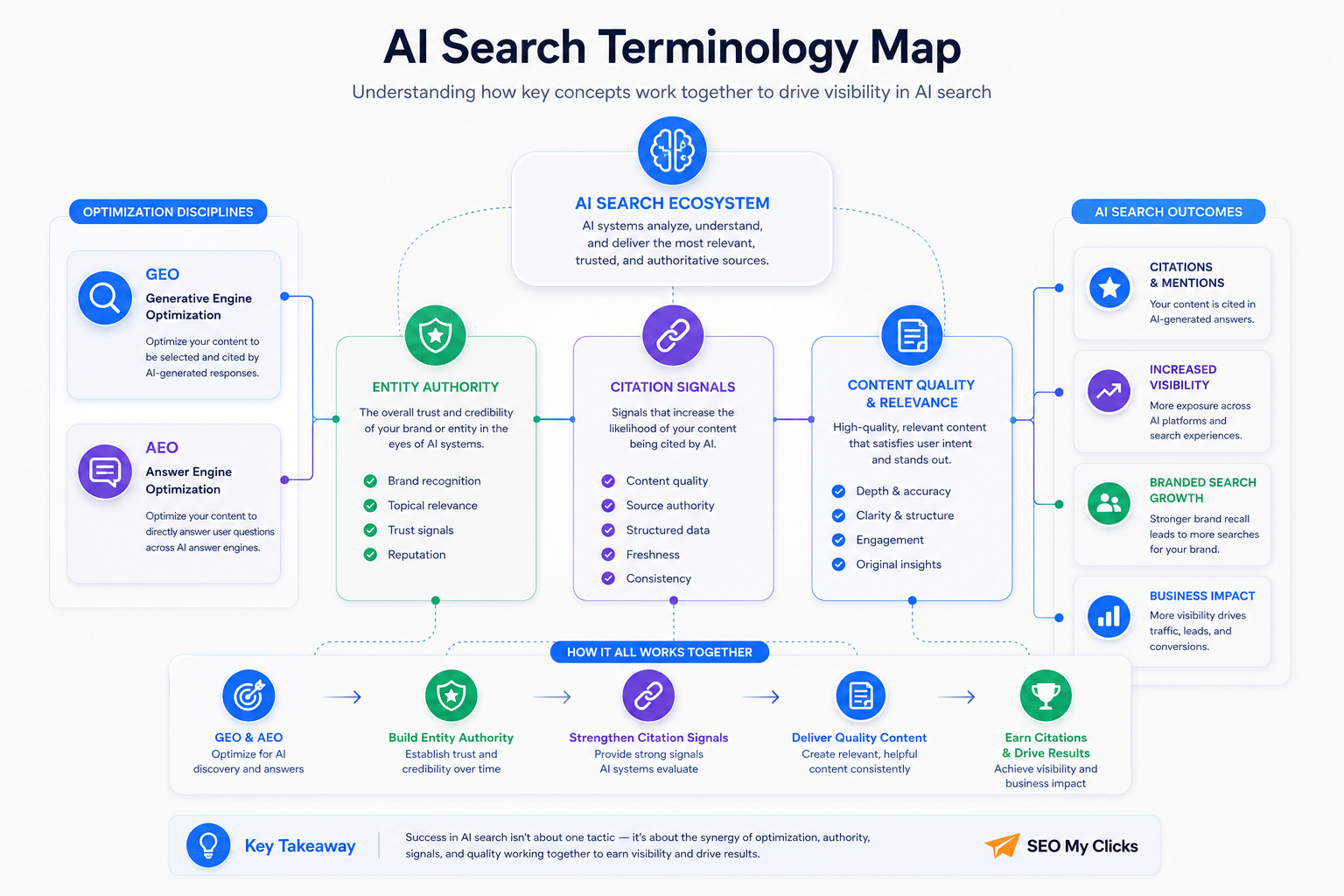
AI search terminology map showing relationships between GEO, AEO, entity authority and citation signals
Conceptual Map

How These Terms Connect

GEO and AEO are the practices. Entity Authority, Citation Signals, and Content Extractability are the mechanisms. AI Visibility Score is the measurement. Zero-Click Search is why it matters. Understanding this hierarchy — practices → mechanisms → metrics → business driver — prevents teams from optimising for symptoms rather than causes. Teams that improve their AI Visibility Score see branded search growth. Teams that build entity authority see citation signals strengthen. All of it connects.

40+
Terms Defined
Better Results
61%
Zero-Click Rate

The Glossary in Context

Use this reference alongside the GEO Implementation Checklist and AEO Content Framework for a complete AI search optimization programme.

AI Search Glossary shown across laptop, tablet and phone
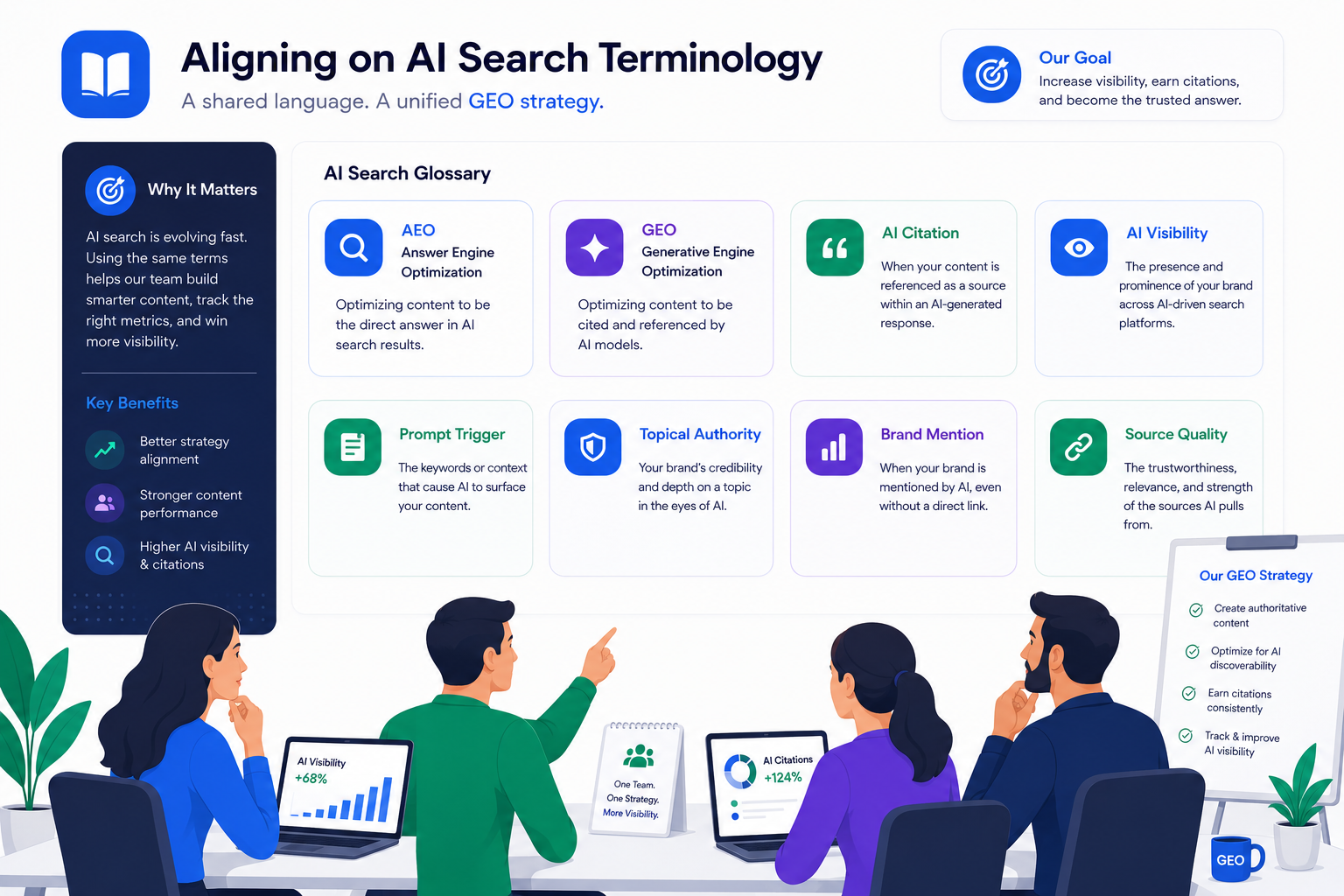
Marketing team aligning on AI search terminology to build a unified GEO strategy
Strategy

Why Vocabulary Determines Strategy

Companies using the wrong vocabulary make the wrong investments. Teams that confuse GEO with SEO run SEO campaigns and wonder why AI citations don't improve. Teams that confuse AEO with content marketing produce blog posts that never win featured snippets. Getting the terminology right aligns strategy, briefs agencies accurately, and measures the right outcomes. The 4× AI visibility advantage we observe between aligned and misaligned teams comes almost entirely from strategy differences caused by vocabulary misalignment.

Three Vocabulary Mistakes That Waste Budget

The most expensive errors in AI search investment come from semantic confusion, not technical failure.

01

"We're doing SEO to improve AI visibility."

SEO and GEO share some signals (domain authority, content quality) but diverge completely on the critical ones. SEO optimizes for backlinks and keyword density; GEO optimizes for content extractability and entity authority. Running SEO without GEO produces Google rankings but not AI citations — different output, different programme.

02

"We publish a lot of content — that's our AEO."

High publishing volume is not AEO. AEO is structuring content to win the answer slot — which requires direct answer openings, question-format headings, FAQ sections, FAQPage schema, and Speakable markup. Publishing the same volume of prose-format articles produces traffic but rarely wins featured snippets or AI Overview citations.

03

"Our domain authority is high, so we should be getting AI citations."

Domain authority is necessary but not sufficient for AI citation. It ensures AI engines can retrieve your content (the first step in RAG). But if your content fails the extraction test — buried answers, no structural markers, missing FAQ sections — high domain authority still results in zero citations. Both retrieval and extraction must succeed.

From Vocabulary to Visibility — Six Steps

Understanding the terms is only the first step. Here's how to translate knowledge into AI citations.

1

Share This Glossary

Distribute this glossary to your marketing team, agency, and any stakeholders involved in content or SEO strategy. Align on shared vocabulary before the next strategy meeting.

2

Audit Your Strategy

Map your current activities against the correct terms. Are you doing GEO or just SEO? AEO or just content marketing? Identify the gaps between what you're calling things and what the terms actually mean.

3

Identify Measurement Gaps

Check whether you're measuring AI Visibility Score, citation frequency, and branded search growth — the GEO metrics. If you're only tracking rankings and traffic, add the AI-specific metrics immediately.

4

Brief Correctly

Rewrite your agency or contractor brief using the precise terminology. Replace "improve AI visibility" with specific requests: GEO content restructuring, entity authority building, Speakable schema implementation.

5

Work the GEO Checklist

Apply the 47-item GEO Implementation Checklist with your new vocabulary clarity. Score yourself against each item and prioritize the highest-impact gaps — technical readiness first, then content structure, then entity authority.

6

Run the AEO Content Framework

Apply the DEEP model (Direct, Extractable, Evidenced, Periodically-updated) to your priority pages. Use the 6-dimension AEO scoring rubric to assess each page before publishing. Target a score of 50+/60.

"We spent 6 months running SEO when what we needed was GEO. Once we understood the difference with SEO My Clicks' help, the entire strategy shifted and results followed within 8 weeks. The glossary has become a standing document our entire growth team references."

Diana L.
Marketing Manager, B2B Tech Platform
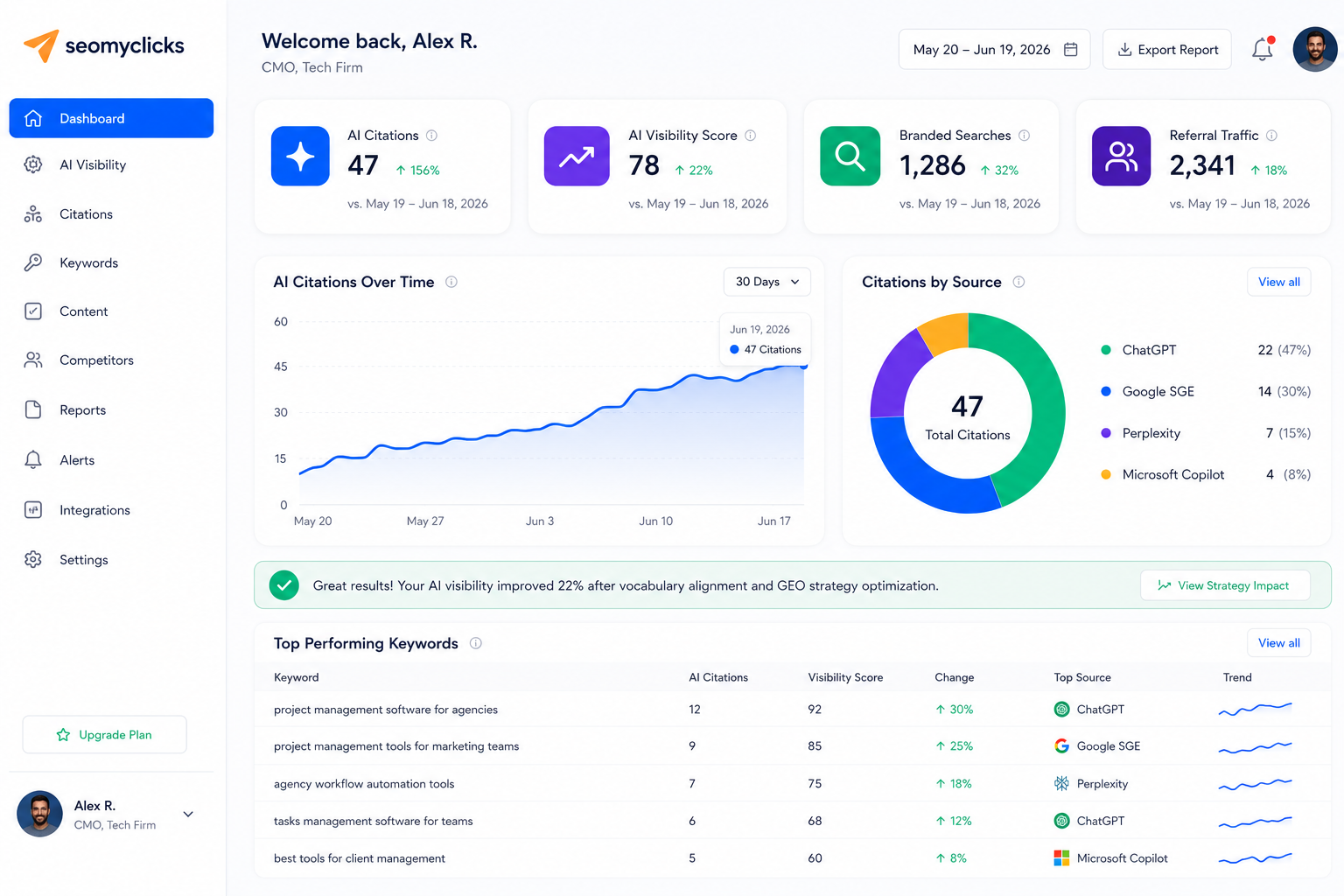
AI citation results after vocabulary alignment and GEO strategy shift
8 Weeks
From vocabulary alignment to first GEO citations

Common Questions About AI Search Terminology

Answers to the questions we hear most often about GEO, AEO, and AI search vocabulary.

What is the difference between GEO and AEO?
GEO (Generative Engine Optimization) focuses specifically on getting your brand cited as a source in AI-generated answers produced by systems like ChatGPT, Perplexity, Gemini, and Google AI Overviews. The goal is brand citation and source mention in AI-written paragraphs. AEO (Answer Engine Optimization) is broader — it targets winning the selected answer position in any answer-presenting system, including voice search, Google featured snippets, AI Overviews, and conversational AI. GEO is about citation; AEO is about winning the answer slot. Both require similar content techniques — direct answers, question-format headings, FAQ schema — but GEO additionally requires entity authority building and cross-platform corroboration that AEO alone does not emphasize.
What does "entity authority" mean in AI search?
Entity authority refers to the degree to which AI engines recognize and trust a brand, person, or organization as an authoritative source of information in a specific domain or topic area. AI engines build entity models from training data, Knowledge Graphs, and web crawling. A brand with high entity authority has a verified Google Business Profile, consistent presence across LinkedIn, G2, Crunchbase, and industry directories, named authors with verifiable credentials, and multiple third-party mentions from authoritative sources. Entity authority is a foundational GEO signal — without it, even technically perfect content may not be cited because the AI engine cannot verify the source's credibility. Building entity authority typically takes 60–90 days of systematic effort across multiple platforms.
What is a citation signal in AI search?
A citation signal is any factor that AI engines evaluate when deciding whether to cite a piece of content in a generated answer. The five primary citation signals are: content extractability (how easily an AI engine can parse a clean answer from your page), entity authority (how well AI engines recognize and trust your brand), freshness (how recently the content was published or updated — 50% of AI-cited content is under 13 weeks old), cross-platform corroboration (how many independent authoritative sources mention the same information), and structured data implementation (whether FAQPage, Article, HowTo, and Speakable schemas are correctly deployed). Strong citation signals across all five dimensions maximize the probability of consistent AI citation across multiple platforms.
How is AI search visibility different from SEO rankings?
SEO rankings measure position in a list of blue links on a Google search results page — the goal is to rank #1, #2, or #3 to capture most of the clicks. AI search visibility measures how often your brand is cited or mentioned in AI-generated answers — there is no ranked list, only cited sources and uncited sources. The signals differ substantially: SEO heavily weights backlinks and keyword relevance, while AI citation weights content extractability, entity authority, freshness, and structured data. The measurement differs: SEO uses rank tracking tools, while AI visibility requires citation audits across ChatGPT, Perplexity, Gemini, and AI Overviews. The timeline differs: SEO takes 4–12 months to move rankings meaningfully, while first AI citations can appear within 6–10 weeks of targeted optimization.
What is content extractability?
Content extractability is the ease with which an AI engine can identify, parse, and extract a clean, complete, direct answer from a web page. High-extractability content has three characteristics: it leads with the answer in the first paragraph (ideally the first sentence), it uses clear structural markers like question-format H2 headings and bulleted or numbered lists, and it avoids burying key information in dense prose paragraphs without structural breaks. Low-extractability content — long context-setting before the answer, no heading hierarchy, flowing paragraphs with no delineation — is significantly less likely to be cited by AI engines even when the underlying information is accurate and relevant. Improving extractability is often the highest-impact single change available for GEO performance. It requires no technical changes, just content restructuring.
What does zero-click search mean for my business?
Zero-click search refers to a search session where the user finds the information they need directly on the search results page — through an AI Overview, featured snippet, or Knowledge Panel — without clicking to visit any website. 61% of Google searches now end without a click. For your business, zero-click search means that even if your content is used to generate an AI answer, you may not receive website traffic from that interaction. However, your brand name may still appear in the AI answer, driving brand awareness and branded search from users who then search directly for your brand. This is why GEO measurement tracks citation frequency and branded search growth alongside traffic — because AI search benefits often manifest as brand signals before they produce direct traffic increases.
What is RAG and how does it affect AI citations?
RAG stands for Retrieval-Augmented Generation — the technical process by which AI search engines retrieve relevant content from the web and use it to augment the answers they generate. When a user asks ChatGPT Search or Perplexity a question, the system first retrieves relevant web pages (the retrieval step using traditional search indexing), then reads and synthesizes those pages into a generated answer that cites the sources (the augmented generation step). Understanding RAG explains why certain content gets cited: the AI retrieves content that matches the query semantically, then selects the most extractable and trustworthy passages to include in its answer. Optimizing for RAG requires passing both steps — strong SEO signals to ensure retrieval, and high extractability to win the citation selection stage.
How is "freshness" defined in AI search?
In AI search, content freshness refers to how recently a page was published or significantly updated. The key freshness benchmark is 13 weeks — approximately 50% of AI-cited content is less than 13 weeks old, suggesting AI citation systems weight recently updated content more heavily than older content on the same topic. Freshness is signalled to AI engines through the dateModified field in Article schema (which AI crawlers specifically check), visible "Last Updated" dates on the page, and recency of the published date in page metadata. The 13-week freshness rule means that a content refresh calendar — updating key pages with new data, new examples, and a fresh dateModified every quarter — is a core component of sustained AI citation performance rather than an optional maintenance task.
Turn Vocabulary Into Visibility

Understanding the terms is step one. SEO My Clicks handles implementation — GEO, AEO, entity authority, schema markup, freshness protocols — so your brand gets cited in AI answers within weeks. Get your free AI visibility audit today.

What our clients say

MR
Marcus R.
marcus@veliomedical.com
Re: 3 months in — wanted to share results
Before SEO My Clicks we had spent £14k on Google Ads with nothing to show for it. They built our organic and AI search presence and we now get consistent qualified leads every week without any ad spend. The dental implant distributor space is competitive and we now show up in Perplexity results consistently.
Mon, 7 Apr · 9:14 AM
JK
jamie_k
#wins · SaaS Founders
Genuinely didn't believe organic + GEO could generate pipeline faster than ads. SEO My Clicks proved me wrong. We went from zero AI search visibility to being cited in ChatGPT answers for our category in under 10 weeks. First inbound from an AI referral last Tuesday
Today at 2:17 PM
NP
Niall P.
@niallp_founder
SDR as a service was exactly what we needed. We couldn't afford a full-time hire but needed someone doing outreach. Within 30 days we had 6 qualified meetings booked with the exact type of client we wanted. No salary, no ramp time.
Tuesday, 10:08 AM
AT
Alisha T.
alisha.t@constructagroup.co.uk
Feedback — 6 months working together
We're a construction materials supplier and had no digital presence at all. SEO My Clicks built our AEO and GEO from scratch. We now appear when procurement managers ask AI tools for suppliers in our category. Three new B2B accounts sourced from AI search in the last quarter alone.
2 Apr 2026, 3:51 PM
rx
roxanne_gtm
#growth-wins · B2B Operators
Just launched 4 months ago and already have 11 paying clients. SEO My Clicks built the outbound engine and GEO presence simultaneously. Would have taken us 18 months to figure this out ourselves.
Yesterday at 6:44 PM
OW
Oliver W.
oliver@physioforward.ie
You won't believe this — ChatGPT recommended us
A new patient told me they found our physiotherapy clinic by asking ChatGPT for recommendations in our area. I had no idea that was even possible. SEO My Clicks had been building our AEO presence for 3 months. It's working.
Fri, 4 Apr · 8:22 AM
DM
dev_marcus
#case-studies · Founders Collective
The team at SEO My Clicks understood our IoT hardware business immediately. No time wasted explaining the industry. GEO optimisation started in week one and by week 9 we were appearing in Gemini answers for procurement-related queries. Genuinely impressive.
Today at 11:03 AM
LF
Lena F.
l.fischer@datasprint.de
Pipeline update — thought you'd want to know
We stopped running paid ads in January and were terrified. SEO My Clicks had been building our organic and AI search presence for 5 months at that point. February was our best lead generation month ever. Zero ad spend. The compounding effect they described is very real.
5 Apr 2026, 10:17 AM
PR
Priya R.
priya@renewapack.com
6 months — here's what changed
We're a packaging manufacturer. Nobody thinks about GEO or AEO in our industry yet. That's exactly why it worked so fast. SEO My Clicks got us cited in AI answers for sustainable packaging suppliers before any of our competitors even knew what GEO was. Three new wholesale accounts this quarter.
Tue, 1 Apr · 2:45 PM
BN
Ben N.
ben@nortonsolicitors.co.uk
Re: How it's going
As a law firm we were completely dependent on referrals. SEO My Clicks changed that. We now have people finding us through Google and through Perplexity searches. The SDR outreach they run on our behalf has added a completely new channel we never had before. Pipeline is finally predictable.
Wed, 2 Apr · 11:33 AM
MR
Marcus R.
marcus@veliomedical.com
Re: 3 months in — wanted to share results
Before SEO My Clicks we had spent £14k on Google Ads with nothing to show for it. They built our organic and AI search presence and we now get consistent qualified leads every week without any ad spend.
Mon, 7 Apr · 9:14 AM
JK
jamie_k
#wins · SaaS Founders
Genuinely didn't believe organic + GEO could generate pipeline faster than ads. SEO My Clicks proved me wrong. First inbound from an AI referral last Tuesday
Today at 2:17 PM
NP
Niall P.
@niallp_founder
SDR as a service was exactly what we needed. Within 30 days we had 6 qualified meetings booked with the exact type of client we wanted. No salary, no ramp time.
Tuesday, 10:08 AM
AT
Alisha T.
alisha.t@constructagroup.co.uk
Feedback — 6 months working together
Three new B2B accounts sourced from AI search in the last quarter alone. SEO My Clicks built our AEO and GEO from scratch and we now appear when procurement managers ask AI tools for suppliers in our category.
2 Apr 2026, 3:51 PM