You spent years training to deliver exceptional dental care. Growing a practice is an entirely different skill set — one that eats the hours you don't have. We build the patient pipeline so you can stay chairside.
At $300–$600 per chair hour, a no-show or last-minute cancellation isn't just frustrating — it's a measurable loss that compounds across the week. And the practices growing fastest right now aren't the ones with the best clinical skills. They're the ones patients can find, trust, and book from the moment they start searching.
Word of mouth still matters. But in 2026, the neighbour who gave you a referral has been replaced by Google Maps, AI answers, and review velocity. A patient with a cracked molar at 9pm Sunday finds whoever shows up first — and books with whoever looks most trusted. That window is three minutes. Most practices miss it entirely.
Understanding this journey shows you exactly where your practice needs to be visible — and where most practices go dark.
Built around how patients discover, evaluate, and choose a dentist in 2026.
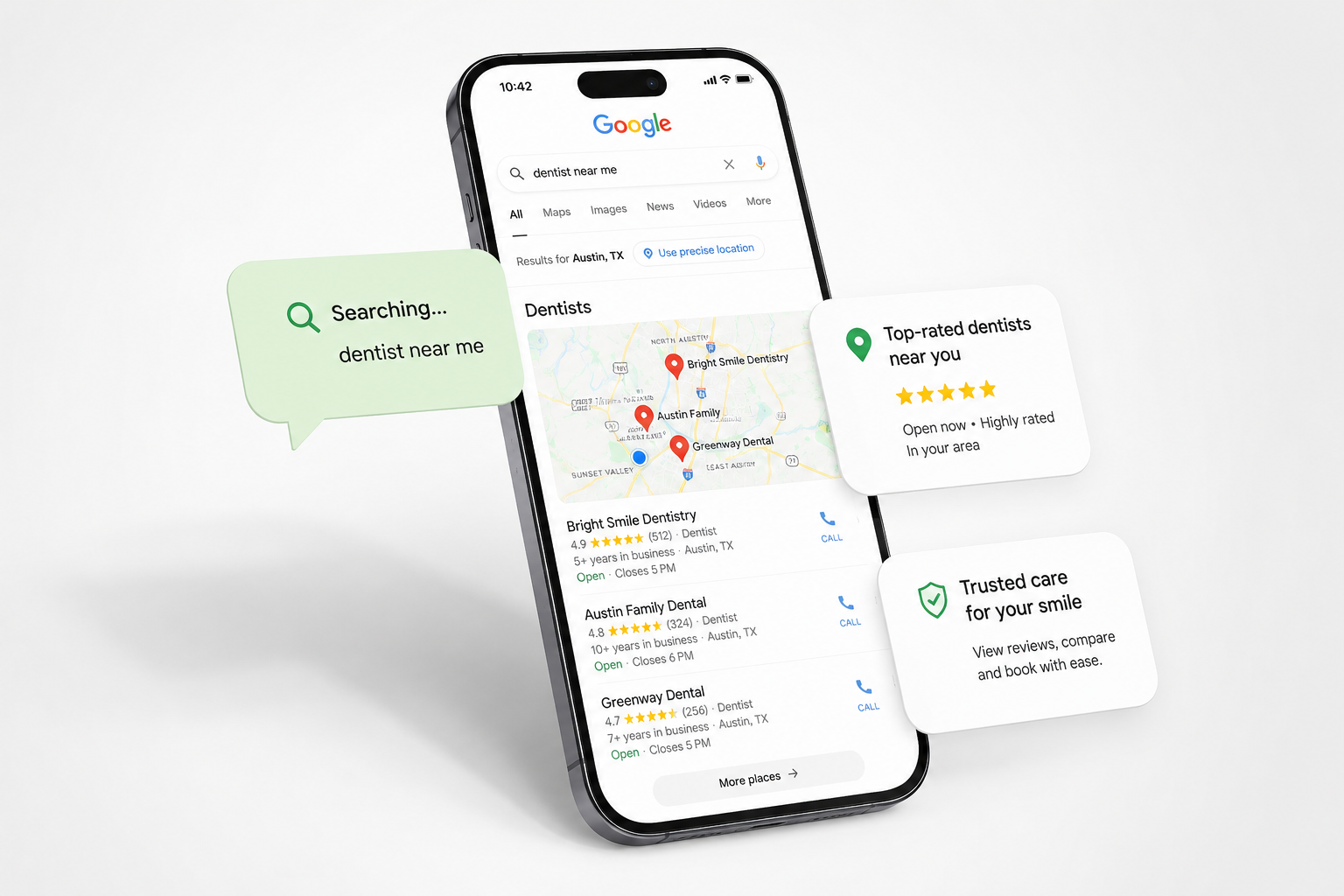
When a patient searches "dentist near me," "emergency dentist open now," or "Invisalign provider [city]" — the three practices in the Maps 3-pack take 48% of all clicks on the page. Everything below them shares the rest.
Getting there isn't about luck or spending more on ads. It's built on a complete and active Google Business Profile, consistent review velocity, accurate local citations, and content that matches exactly how patients search — including the neighbourhood, the procedure, and the urgency.
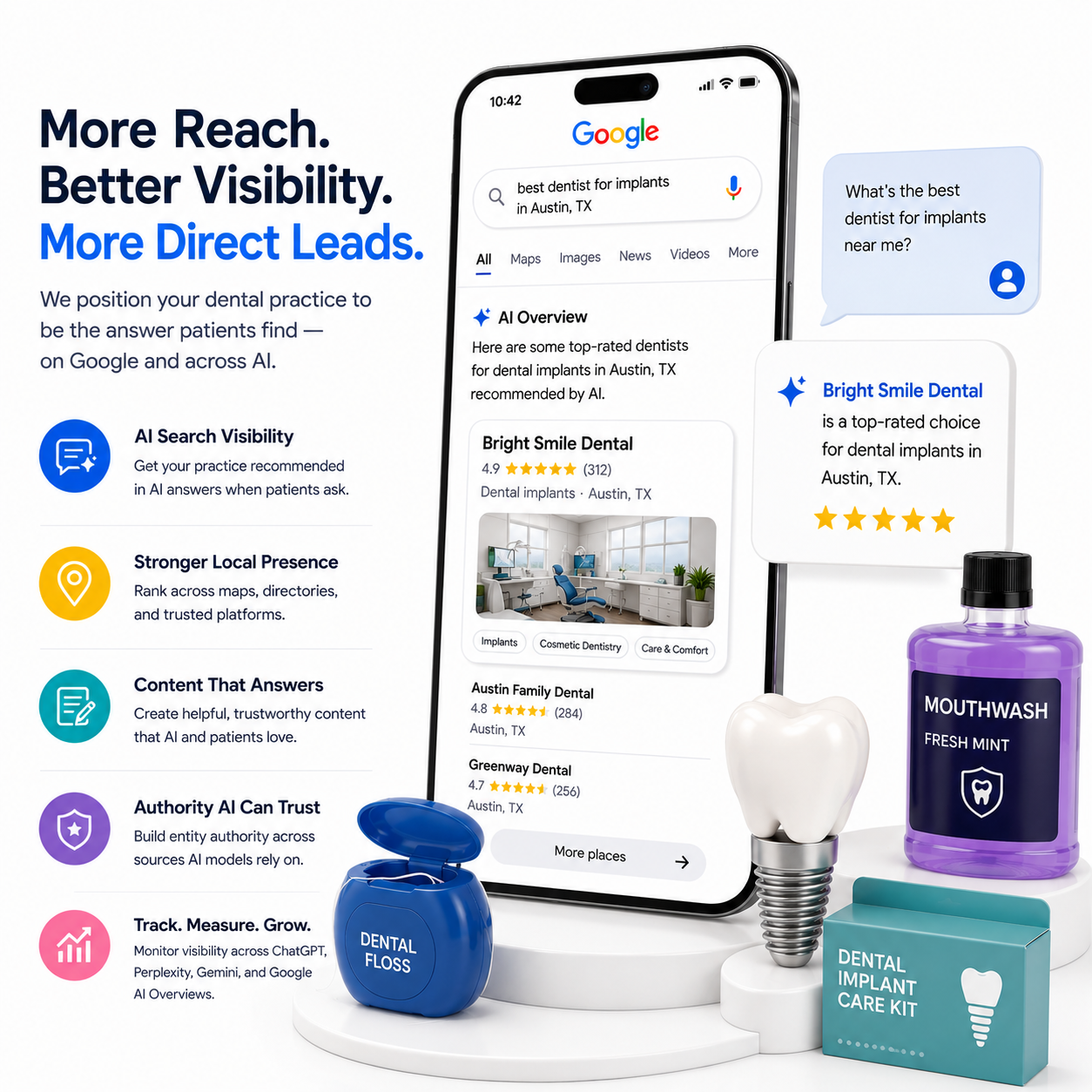
A growing number of patients — especially for high-consideration procedures like implants, Invisalign, and cosmetic work — now ask AI directly. "Best dentist for implants in [city]." "How much does Invisalign cost near me." "Is teeth whitening safe."
AI answers these with named recommendations. Practices in those answers get the call. Practices not in those answers don't exist in that patient's decision process — regardless of how good their Google ranking is. Two different visibility layers. Both require different work.
Great marketing for a dental practice isn't one thing. It's a system where every part reinforces the others.
High-value procedures have long consideration cycles — weeks of research before a call. We build dedicated pages, content, and campaigns for each one so you're present throughout that entire journey.
Each procedure gets its own page, keyword strategy, review focus, and campaign. The practice with a dedicated implants page outranks the one with a generic "services" page every time.
You run a tight, quality practice. Patients love you. But you're spending evenings wondering why your schedule has gaps on Tuesdays and why your competitor keeps showing up in Maps. We take all of it off your plate — local visibility, AI search, reviews, social — so you can be chairside and not at a laptop at 10pm.
An implant patient researches for six to twelve weeks before calling. The practice visible throughout that entire journey wins the $5,000 case. We build procedure pages, AI answers, and social content so your name is familiar by the time they pick up the phone.
Each location needs its own Google Business Profile, review velocity, local citations, and neighbourhood-level pages that match how patients in that area search — not one generic campaign stretched across multiple postcodes.
A new practice cannot wait 18 months for organic growth. We run paid acquisition alongside local SEO and AI visibility simultaneously — so you have a pipeline from week one, not month nine. And because we work with one practice per city, your market is protected the moment you sign.
No long discovery process, no pitch deck. Here is exactly what happens next.
Things most agencies won't commit to.
Fill in the form and we'll come back within one business day with a snapshot of your local search visibility, your Maps position, AI search presence, and the three highest-leverage changes for your market. No call required.
Patients are searching right now. Some will find your practice. More of them should. Let's close the gap between the care you provide and the patients who need it.