The clearest breakdown of Sales Development Representatives vs Business Development Representatives — what each role does, who they report to, what KPIs they hit, when to hire which, and how to get both functions running without the cost or ramp time of in-house hiring.
The terms SDR and BDR are used interchangeably at many companies, which creates confusion when hiring, when building comp plans, and when measuring performance. Understanding the actual distinction — not just the semantics, but the operational reality of what each role does — is critical to making the right decision for your sales motion.
An SDR (Sales Development Representative) is historically a hybrid role: they qualify inbound leads generated by marketing (form fills, content downloads, webinar registrations) and do light outbound prospecting to companies that match the ICP. The SDR's primary output is qualified meetings — conversations they have with prospects to confirm BANT fit (budget, authority, need, timeline) and schedule a discovery call with an account executive. SDRs book 40-60% of all B2B qualified meetings at companies with a functioning marketing-generated inbound flow.
A BDR (Business Development Representative) is purely outbound. No inbound support. No marketing-generated leads to qualify. The BDR identifies target accounts, builds contact lists, crafts outreach sequences, and works to get meetings with decision-makers at companies that have never heard of you. BDRs typically target larger deals — enterprise or upper mid-market — with more complex buying committees and longer sales cycles. BDRs generate 35% of enterprise pipeline at companies with mature outbound programs.
The practical distinction comes down to two things: the source of your pipeline activity (inbound vs. cold outbound) and the size and complexity of deals being targeted. If your marketing generates leads and you need someone to follow up fast and qualify them, that's an SDR motion. If you have no inbound and need to hunt enterprise accounts from scratch, that's a BDR motion. Many companies need both — but launching both simultaneously without the right infrastructure (CRM, sequences, data enrichment, ICP definition) is expensive and slow to produce results.
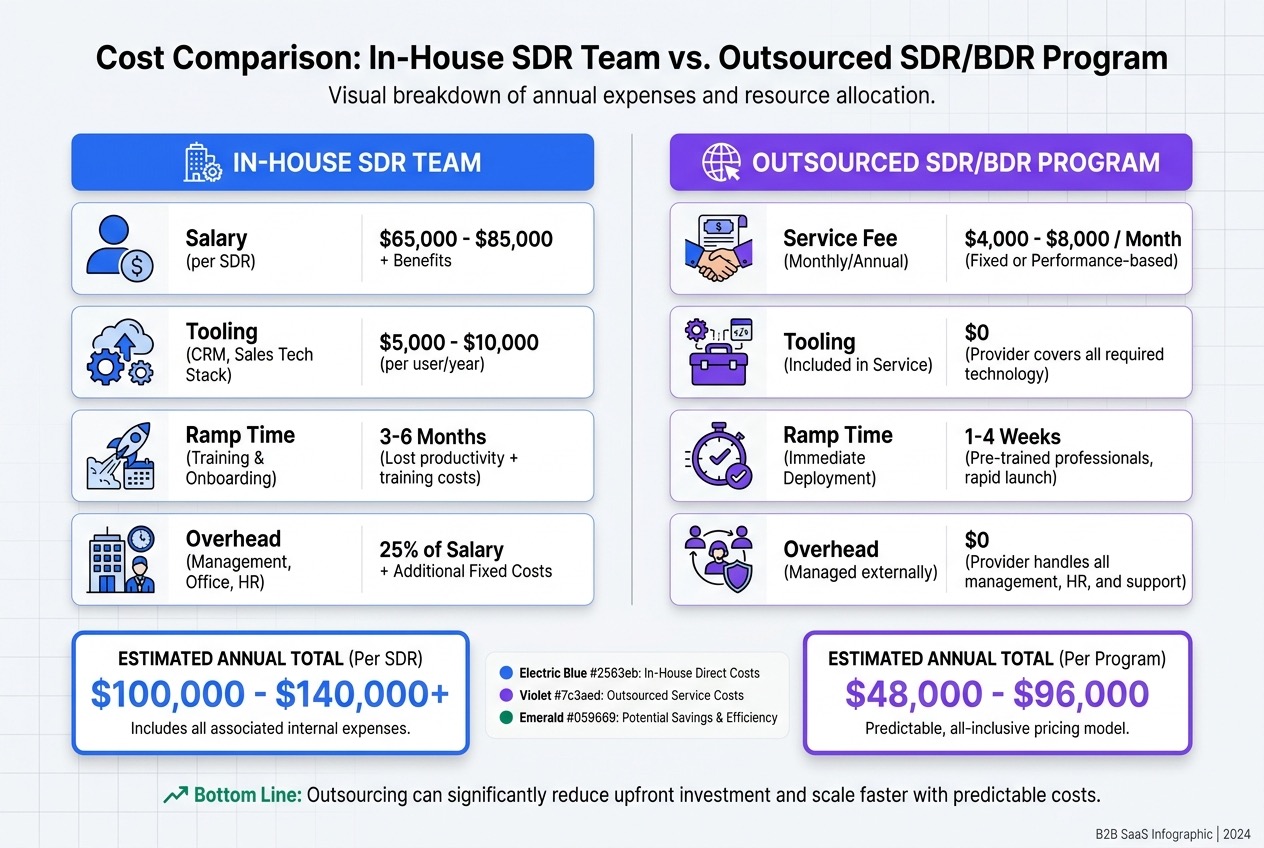
The alternative — and the model that produces the fastest pipeline with the lowest cost per meeting — is an outsourced SDR/BDR program with an experienced partner who already has the infrastructure built. The average in-house SDR costs $85,000 per year fully loaded, takes 3-6 months to ramp, and requires a manager's time to coach and develop. An outsourced program through SEO My Clicks delivers qualified meetings starting in week two, at a cost-per-meeting that is on average 60% lower than equivalent in-house resources. The math for most B2B companies at growth stage is clear.
Qualifies inbound leads from marketing campaigns and does light outbound prospecting to ICP companies. Runs qualification calls, confirms BANT fit, and books discovery meetings for account executives. Reports to VP of Sales or Sales Dev Manager.
Purely outbound — identifies target enterprise accounts, builds contact lists, executes multi-touch sequences via email and LinkedIn, cold calls, and works to get meetings with senior decision-makers. No inbound assist, pure cold pipeline creation.
Emails sent per day (50-100), LinkedIn touches (10-20/day), meetings booked per week (5-10), meetings held and qualified, MQL-to-SQL conversion rate, and opportunities created from SDR pipeline.
Accounts targeted per week, multi-stakeholder contacts engaged per account, meetings booked with senior decision-makers, pipeline value generated per month, and revenue influenced from BDR-sourced deals.
Hire or activate an SDR motion when: you have inbound leads not being followed up quickly, deal size is under $25K ACV, and you're targeting SMB or mid-market with shorter sales cycles. Activate a BDR motion when: you need to build pipeline from zero, you're targeting enterprise accounts with $50K+ ACV, and you need multi-stakeholder outreach over 3-6 month cycles. Most growth-stage companies need both — but sequence the build correctly.
SDR for inbound-led growth, BDR for outbound-led enterprise
In-house: $85K+ per year, 3-6 months ramp, manager overhead. Outsourced: meetings start in week 2, no ramp, no benefits, 60% lower cost per meeting. The right choice depends on your stage and capital position.
CRM (Salesforce, HubSpot), sales engagement platform (Outreach, Apollo, Salesloft), data enrichment (ZoomInfo, Clay, Apollo), LinkedIn Sales Navigator, and dialer if phone-heavy. The stack costs $500-$1,500/month minimum.
Understanding the day-to-day reality of SDR and BDR roles helps you evaluate whether you're hiring the right person for the right function — and avoid the expensive mistake of misaligning role to motion.
An SDR's day typically includes: checking for new inbound leads (form fills, chat inquiries, webinar registrations) in the CRM, calling and emailing new inbound leads within the first 5 minutes of receipt (speed-to-lead is critical), running light outbound sequences to ICP-matched companies in parallel, qualification calls using a structured discovery framework, and updating CRM with qualification notes before handing off to an AE for a full discovery call.
A BDR's day includes: researching 10-20 target accounts using LinkedIn, Apollo, and intent data; building and verifying contact lists; writing personalized outreach emails; executing multi-touch sequences across email and LinkedIn; following up on replies and handling objections; and scheduling intro calls with interested prospects for handoff to account executives.
Both roles succeed or fail based on the quality of the ICP, the relevance of the messaging, and the infrastructure supporting them. Without a defined ICP, both roles spend enormous time on non-ideal prospects. Without good messaging, all the activity in the world produces low reply rates.
From CRM pipeline view to daily task management — the operational reality of a high-output SDR/BDR program.
SDRs and BDRs manage daily tasks from a sequenced queue — emails, LinkedIn touchpoints, and call tasks prioritized by prospect engagement score and sequence step. Mobile access keeps the pipeline moving even when the team is between calls.
The most expensive SDR/BDR mistake isn't paying too much. It's hiring the wrong role for the wrong motion. A BDR doing SMB outreach burns time on accounts too small to justify the outreach investment. An SDR doing pure enterprise outbound without inbound support has no warm pipeline to qualify — they're cold-hunting with tools and compensation designed for warm qualification.
The second most expensive mistake is hiring before you have the infrastructure. An SDR or BDR without a CRM, a sequence tool, a verified contact list, a clear ICP, and a structured qualification framework is a very expensive experiment. They'll spend their first 60 days building the infrastructure themselves — badly — and your ramp time doubles.
The third mistake is underestimating total cost. The base salary is visible. The benefits, payroll taxes, equipment, software stack, manager time, and recruiting cost add up to a fully loaded cost of $85,000-$120,000 for an SDR and $100,000-$150,000 for a BDR. Plus a 3-6 month ramp before you see meaningful pipeline. The math favors outsourcing until you're at a stage where managing and scaling an in-house team is itself a strategic priority.
These are the three scenarios that bring B2B companies to us to fix their outbound function.
SDR hired for inbound qualification but there's no inbound — they spend all day cold prospecting without the tools or comp structure for it. BDR hired but they're qualifying marketing leads that should be going to an SDR. Role-motion mismatch is expensive.
SDR or BDR hired without a CRM, no sequence tool, no verified contact lists, no ICP definition. They spend 60 days building what should have been ready before their first day — and the pipeline suffers.
3-6 months of salary, benefits, and manager time with 0-3 meetings per month while the SDR ramps. By the time they reach full productivity, the company has spent $50K-$75K with minimal pipeline to show for it.
Six steps to go from no outbound function to qualified meetings in your calendar.
Inbound-led or outbound-led? What's your average deal size? How long is your sales cycle? These answers determine whether you need SDR, BDR, or both — and in what sequence.
Under $25K ACV with a 30-90 day sales cycle? SDR motion. Over $50K ACV with 90-180 day cycle and multi-stakeholder buying committees? BDR motion with account-based approach.
SDR for qualifying inbound plus light outbound to ICP. BDR for heavy outbound to enterprise accounts. Or outsource both with a partner who runs both motions simultaneously.
CRM, sales engagement platform, data enrichment tool, and LinkedIn Sales Navigator as the minimum viable stack. This infrastructure must exist before any SDR or BDR starts outreach.
Precise ICP definition with firmographic and psychographic criteria. Build verified contact lists from Apollo, ZoomInfo, or LinkedIn. Verify emails before sending to protect domain health.
Launch 8-10 touch multi-channel sequences. Track reply rate, meetings booked, meetings held, and opportunities created weekly. Iterate messaging based on what the market responds to.
We thought we needed a full sales team. We were looking at hiring three people. SEO My Clicks showed us we needed one focused outbound function, properly resourced, with the right ICP and messaging. We outsourced the BDR motion to them and meetings started coming in week 2. The clarity they brought to our sales motion alone was worth the engagement.
We run SDR and BDR programs for B2B companies — with the ICP definition, tech stack, contact data, messaging, and execution already built. First meetings within 2 weeks, at 60% lower cost-per-meeting than in-house.
What our clients say