The definitive playbook for building, launching, and scaling in new markets — covering ICP definition, competitive positioning, messaging frameworks, channel sequencing, and revenue acceleration. For SaaS, product companies, and services entering or expanding markets in 2026.
The most dangerous misconception about go-to-market strategy is that it's a deliverable — a slide deck you build in a planning session, present to leadership, and then file away. That's not a GTM strategy. That's a pitch deck wearing a GTM hat. A real go-to-market strategy is a live operating system: a set of decisions, processes, and metrics that govern how your company finds customers, earns their trust, and converts that trust into revenue.
According to CB Insights and Gartner research, 75% of new product failures happen not because the product wasn't good enough, but because the company didn't go to market correctly. They targeted the wrong buyer, used the wrong channels, delivered the wrong message, or tried to close deals before the market understood the problem they were solving. GTM failure is the leading cause of startup and product death — and it's entirely preventable.
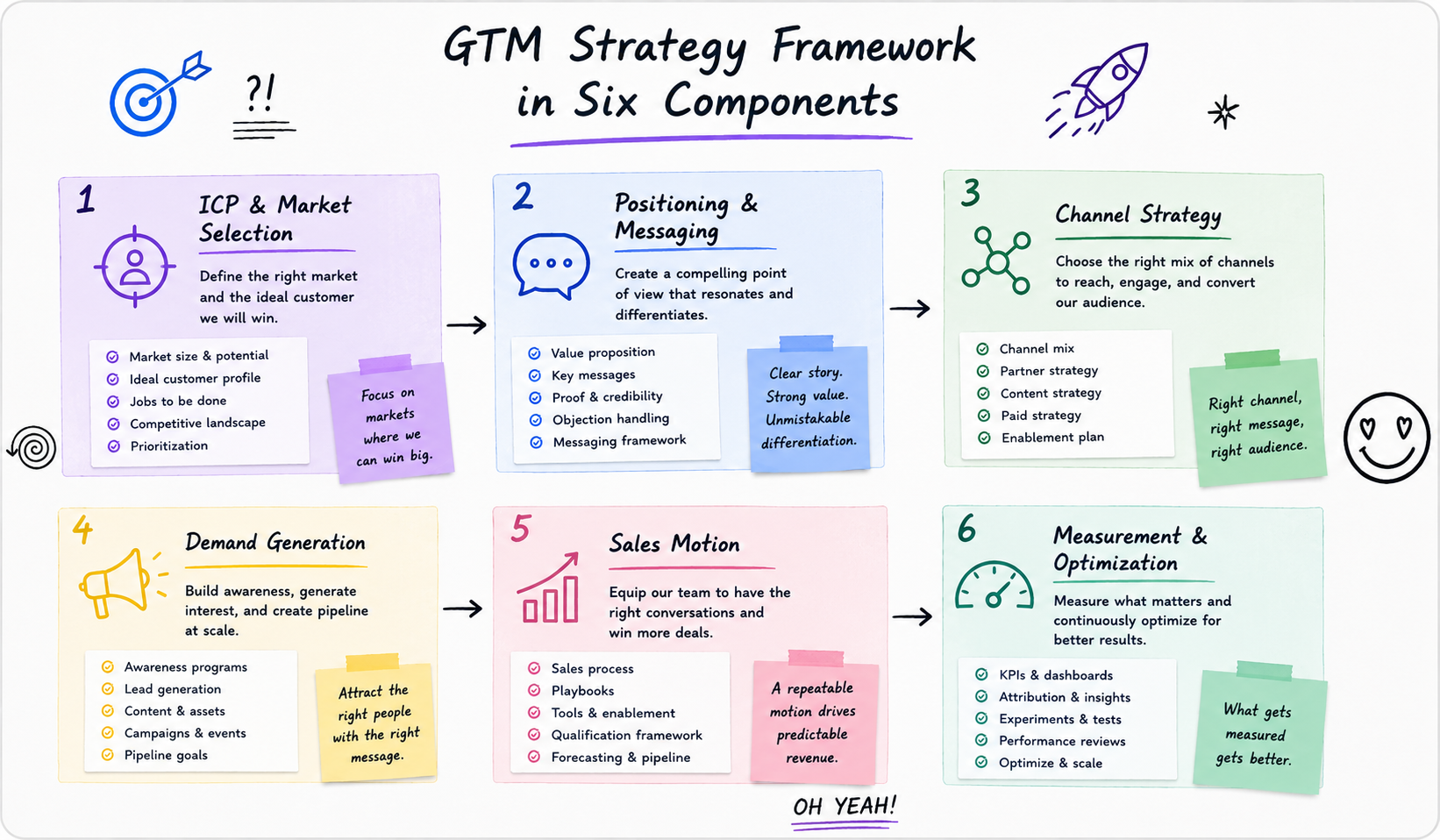
A complete go-to-market strategy has six components that must work together. First is ICP definition — you cannot go to market if you don't know precisely who you're going to. Not "companies with 50+ employees" but the specific firmographic, psychographic, and behavioral profile of the buyer who will say yes fastest and stay longest. Second is competitive positioning — finding the specific dimension on which you can win convincingly for that ICP, differentiating not on features but on outcomes. Third is messaging — translating that positioning into language your buyer uses, focused on their pain and their desired outcome, not your product specifications.
Fourth is channel strategy — determining which channels reach your ICP at what stage of their buying journey, and in what sequence to activate them. Not all channels simultaneously, but a prioritized sequence that starts with what generates feedback fastest. Fifth is pipeline launch — the coordinated activation of outbound sequences, content creation, digital visibility, and referral programs. Sixth is revenue accountability — the metrics, cadences, and kill/double decisions that make a GTM strategy dynamic rather than static.
Companies with clear positioning charge 23% more than generic alternatives, close deals 33% faster, and build more predictable revenue because buyers can articulate why they chose them. In 2026, with AI search changing how buyers discover vendors and GEO/AEO becoming essential visibility channels, GTM strategy must also include how your brand appears in AI-generated answers — a dimension that most GTM frameworks haven't caught up to yet.
Whether you're launching a new product, entering a new market, or rebuilding a GTM motion that isn't producing results, this guide covers every component in the order you should build them — because sequence matters as much as substance in GTM execution.
A GTM strategy is not a slide deck. It is a live operational system — a set of decisions about who you're selling to, how you're reaching them, what you're saying, and how you're measuring results. It governs every function from marketing to sales to customer success. Without it, every team is running in a different direction with different definitions of success.
ICP → Positioning → Messaging → Channels → Pipeline → Accountability
Firmographic, psychographic, and trigger-event definition of your best-fit buyer. Not broad segments — specific profiles with specific buying signals that tell you exactly who to target first.
Find the white space your ICP cares about that competitors aren't owning. Define your differentiation on one or two dimensions you win convincingly — not a list of feature comparisons.
Prioritized sequence of channels based on your ICP's behavior and your deal size. Which channels get activated first, which are scaled after validation, and which are deprioritized given your resources.
Pain-led, outcome-focused messaging that speaks in your buyer's language. Headlines, one-liners, objection responses, and email copy all rooted in the specific problem your ICP is trying to solve.
The coordinated timeline for activating outbound, launching content, building digital visibility, and establishing referral systems — with clear owners, deadlines, and success metrics for each workstream.
Weekly and monthly GTM metrics tied to revenue, not activity. Kill what's not working. Double what is. GTM strategy that doesn't include a measurement and iteration system is strategy without accountability — and that's just planning.
Most GTM frameworks focus on marketing channels and miss the upstream decisions that determine whether any channel will work. ICP, positioning, and messaging must come before channel activation — because even the best channel strategy fails with the wrong message to the wrong buyer.
Component one is ICP: define your best-fit buyer with precision — the specific firmographic profile, the psychographic reality of what they care about, and the trigger events that open a buying window. This is not a 2-hour exercise. It requires reviewing your best and worst customers, interviewing recent wins and losses, and building a profile based on evidence, not assumptions.
Component two is positioning: what do you offer that the ICP cannot get as well from alternatives? Not a feature list but a specific outcome claim that is true, demonstrable, and differentiated. Component three is messaging: the specific language that makes your ICP feel seen — the words, frames, and evidence that make them believe you understand their problem better than anyone else.
Only then do you get to channel strategy, launch sequencing, and revenue accountability. The sequence is the strategy.
GTM planning dashboards and mobile metrics tracking — the operational layer that keeps strategy accountable to revenue.
Revenue accountability on the go. GTM leaders need visibility into pipeline velocity, conversion rates by channel, and deal stage distribution in real time — not in a monthly report that's already outdated by the time it's read.
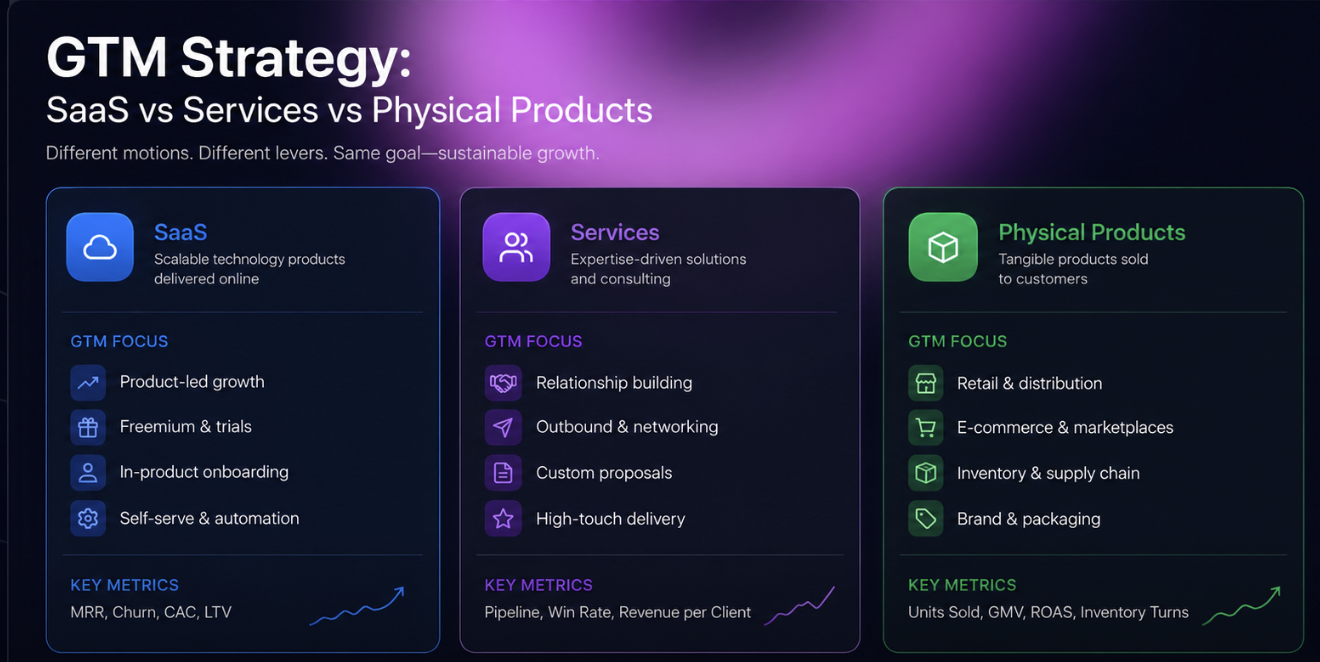
The GTM framework is the same across business types, but the execution differs significantly based on how value is delivered and how buyers make decisions. Understanding these differences is critical to not copying a GTM playbook designed for the wrong business model.
SaaS GTM is typically product-led or sales-led depending on deal size. PLG (product-led growth) works when the product can be tried without a sales conversation — freemium, free trial, or self-serve onboarding generates leads without an SDR. Sales-led GTM works for SaaS with longer enterprise sales cycles, where the buyer needs a consultative conversation before committing. Most SaaS companies need both motions, activated at different deal sizes.
Services GTM is relationship and reputation-led. Content authority, referral systems, and case study evidence carry far more weight than product demos. The GTM investment is in thought leadership, SEO, and targeted outbound to past industry relationships. Physical product GTM focuses on distribution channel selection — direct, retail, wholesale, or marketplace — before any marketing channel decisions are made.
These are the failure modes we see most often — and they're all fixable before they kill the launch.
A 40-slide GTM deck that took 3 weeks to build and 3 days to forget. Without execution infrastructure — sequences launched, content published, metrics tracked — strategy is just aspiration.
Defining ICP as "companies with more than 50 employees" targets 80% of the market and wins none of it. Without precision targeting, messaging is generic and conversion rates are near zero.
Spreading thin budget across SEO, cold email, paid ads, LinkedIn, and events simultaneously with no prioritization. Result: no channel gets enough investment to validate, and all of them underperform.
Six steps from market-entry ambiguity to first revenue — in sequence.
Firmographic, psychographic, and trigger-event analysis. Interview recent wins and losses. Build an evidence-based ICP that your whole team aligns on.
Map competitive landscape. Identify white space your ICP cares about. Define your 1-2 dimensions of differentiation and build proof points that make the claim credible.
Pain-led, outcome-focused messaging for every buyer role and every channel — website, email, LinkedIn, sales calls. Language that makes your ICP feel understood.
Rank channels by speed to feedback, cost, and ICP fit. Build the sequenced activation plan — what launches in week 1, week 4, week 8 — with clear budgets and owners.
Simultaneous activation of outbound sequences, content for GEO/AEO/SEO, and digital visibility. First meetings targeted within 21 days of launch.
Weekly GTM metrics review. Kill underperforming channels fast. Double investment into what's working. Iterate messaging based on what the market responds to.
We had been trying to break into the US market for 8 months. Webinars, cold emails, LinkedIn posts — nothing was converting. SEO My Clicks rebuilt our GTM from the ICP up. They tightened our positioning, rewrote our outreach messaging, and got us our first US contracts within 6 weeks of engagement. The ICP work alone was worth the entire engagement.
We work with SaaS companies, product businesses, and service firms to build GTM strategies that actually launch — with first revenue targeted within 42 days of engagement.
What our clients say