What We Do
Who We Work With
Product Companies
Medical Device Manufacturers Dental Implant Suppliers Surgical Equipment Companies Supplement & Nutraceutical Brands Pharmaceutical Wholesalers Diagnostic Equipment Makers Industrial Machinery Manufacturers Safety Equipment Suppliers Packaging Manufacturers Chemical & Materials Suppliers Construction Materials Companies HVAC Equipment Suppliers IoT & Hardware Manufacturers Networking Equipment Suppliers Robotics & Automation Companies Security Hardware Manufacturers AgriTech Product Companies Renewable Energy Equipment Fashion & Apparel Wholesale Food & Beverage B2B Distribution Cosmetics & Beauty Wholesale Office Equipment & Supplies
Service Businesses
IT & Managed Service Providers Cybersecurity Firms Software Development Studios Cloud Solution Providers Data Analytics Consultancies AI Implementation Firms Management Consultancies HR & Recruitment Agencies Executive Search Firms Business Coaches & Advisors Training & Development Companies PR & Communications Firms Law Firms & Solicitors Accountancy Practices Financial Advisors & Planners Mortgage & Insurance Brokers M&A Advisory Firms Architecture Firms Interior Design Studios Structural Engineering Firms Facilities Management Companies Freight & Logistics Companies
Practitioners & Clinics
Dentists & Dental Clinics Therapists & Counsellors Psychologists & Psychiatrists Cosmetic Surgeons & Clinics Physiotherapists & Chiropractors Nutritionists & Dietitians Fertility Clinics Optometrists & Eye Clinics Hearing Care Specialists Specialist Medical Practices
Growth-Stage & Funded
SaaS & Software Companies Fintech & Financial Services HealthTech & MedTech EdTech & Online Learning PropTech & Real Estate Tech LegalTech Platforms Supply Chain & LogisticsTech Recruitment & HRTech Video Production Companies Branding & Creative Agencies Corporate Catering & Events Corporate Travel Management
How It Works
Resources
Contact Get a Growth Audit →
Resource Guide

GEO vs SEO:
The 2026
Comparison

Generative Engine Optimization and Search Engine Optimization target different systems, use different signals, and require different content strategies. Here is exactly how they differ — and why you cannot afford to do only one.

Why Both Matter
2.3×
More digital visibility when GEO + SEO run together
53%
Web traffic still from SEO
300%
AI search YoY growth
47%
Searches show AI answer
GEO + SEO = Full Coverage
ChatGPT & Perplexity Optimization
Google AI Overviews Strategy
Traditional SEO Rankings
Entity Authority Building
Dual-Signal Content Strategy
The Core Distinction

GEO vs SEO: Two Systems,
Two Different Games

Understanding the fundamental difference between GEO and SEO is the first step to building a 2026 digital visibility strategy that actually works.

What SEO Does

Search Engine Optimization has been the dominant digital marketing discipline for 25 years. It works by helping search engines — primarily Google — understand, trust, and rank your web pages in their results. When someone types a query into Google, SEO determines whether your page appears in position 1, position 5, position 20, or not at all. SEO works through keyword relevance (your content matches what people search for), domain authority (other trusted websites link to yours), technical health (your site is fast, crawlable, and well-structured), and user experience signals (people engage positively with your content). A strong SEO programme takes 4–12 months to produce meaningful ranking gains, but once established, it compounds — creating a pipeline of organic traffic that grows without ongoing advertising spend. SEO still drives 53% of all web traffic and remains critical for bottom-of-funnel transactional queries, local search, and branded visibility.

What GEO Does

Generative Engine Optimization is an emerging discipline created by a fundamentally different question: how do you appear inside an AI-generated answer, not just in a list of links? When a user asks ChatGPT "what is the best B2B lead generation agency in Miami?" or asks Google "how do I optimize for AI search?", an AI engine generates a paragraph-form answer and cites 2–5 sources inside that answer. GEO determines whether your brand is one of those cited sources. GEO works through content extractability (can the AI pull a clean, complete answer from your page?), entity authority (does the AI recognise your brand as a trusted entity in your category?), answer-format structure (do you use direct opening sentences, question-format headings, and FAQ sections?), freshness signals (50% of AI-cited content is less than 13 weeks old), and cross-platform corroboration (do multiple trusted sources mention your brand?). GEO optimizations typically produce initial citations within 6–10 weeks, significantly faster than traditional SEO ranking improvements.

Where They Overlap

GEO and SEO are not entirely separate disciplines — they share a significant foundation. High-quality, accurate, well-structured content is the bedrock of both. Technical site health (speed, crawlability, mobile-responsiveness) matters for both. Domain authority, while more central to SEO, also influences GEO because AI systems are more likely to cite brands that appear frequently in trusted sources. This overlap means that a well-executed SEO programme creates a foundation that accelerates GEO performance. Brands with strong SEO authority tend to start appearing in AI citations faster than brands starting from zero. Conversely, GEO optimizations — particularly the shift toward answer-format content and comprehensive FAQ coverage — also improve SEO performance by improving featured snippet eligibility and E-E-A-T signals.

The 2026 Strategic Imperative

The fundamental reason you cannot afford to do only one of these is behavioral. Your buyers are using both systems simultaneously. A B2B buyer researching your category will type a question into ChatGPT or Perplexity to get a synthesised overview, then open Google to find specific vendors to evaluate. If you appear in the AI answer but not in Google, you get awareness without conversion. If you rank in Google but not in AI answers, you miss buyers who never reach the blue links at all. Running GEO and SEO together delivers 2.3× more overall digital visibility than either alone — because they cover complementary touchpoints in a buyer's research journey. Companies that run both have a compounding advantage over competitors that have invested in only one. The window to build early GEO authority is open right now. Most competitors have not started.

Signal Comparison

SEO Signals vs GEO Citation Signals

SEO

Traditional SEO Ranking Signals

Backlinks from authoritative domains, on-page keyword relevance, technical site health (Core Web Vitals, speed, mobile), user engagement metrics, content depth and topical authority. Google's algorithm weighs hundreds of signals built up over months and years.

  • Domain authority via backlink profile
  • Keyword matching and semantic relevance
  • Core Web Vitals and technical health
  • E-E-A-T (Experience, Expertise, Authority, Trust)
GEO

GEO Citation Signals

Content extractability, entity recognition, freshness (13-week cycle), cross-platform corroboration, and answer-format structure. AI citation selection is query-by-query — different from accumulated authority.

Key Difference

Link Authority vs Entity Authority

SEO builds link authority — the accumulated weight of domains pointing to yours. GEO builds entity authority — how well AI systems recognise and trust your brand as an entity in your category. Distinct, but complementary.

Timeline

4–12 Months vs 6–10 Weeks

6–10
Weeks to first GEO citation (vs 4–12 months for SEO ranking)
Content Format

Prose vs Answer-First Structure

SEO rewards depth and comprehensiveness. GEO rewards directness — leading with the answer in the first 50 words, using question-format H2 headings, and structuring content for machine extraction.

Measurement

Rankings & Traffic vs AI Citation Rate

SEO is measured via Google Search Console rankings and organic traffic sessions. GEO is measured via manual citation audits across ChatGPT, Perplexity, Google AI Overviews, and Gemini — tracked as an AI Visibility Score.

Together
2.3×
More total digital visibility when GEO + SEO run simultaneously vs either alone
Freshness

The 13-Week GEO Rule

50% of AI-cited content is less than 13 weeks old. GEO requires a content freshness protocol — regular updates with new data, updated publication dates, and refreshed schema — that SEO alone does not demand.

Side-by-Side

The Complete GEO vs SEO Comparison

Every major dimension compared so you can see exactly where the strategies diverge and where they reinforce each other.

Dimension GEO SEO
Target SystemAI engines (ChatGPT, Perplexity, Gemini, Google AI Overviews)Traditional search engines (Google, Bing)
OutputCited inside an AI-generated answerRanked in a list of blue links
Primary SignalContent extractability + entity authorityBacklinks + keyword relevance
Content FormatAnswer-first, question-format headings, FAQ sectionsComprehensive, keyword-rich, depth-focused
Time to First Result6–10 weeks to first AI citation4–12 months to meaningful ranking gains
Schema PriorityFAQPage, HowTo, Speakable, Article schema criticalSchema helpful but not essential for rankings
Freshness Requirement13-week refresh cycle — 50% of citations are recent contentFreshness a signal but long-evergreen content ranks well
MeasurementAI Visibility Score, citation audit across 4 platformsKeyword rankings, organic traffic, GSC data
Technical RequirementsAI bot allowlist in robots.txt, AI-specific meta tags, Speakable schemaCore Web Vitals, crawlability, sitemap, canonical tags
Authority TypeEntity authority (AI recognises brand as trusted entity)Domain authority (link equity from trusted domains)
GEO and SEO strategy working together for complete digital visibility
What SEO Delivers

SEO: The Foundation of Organic Traffic

Traditional SEO remains the bedrock of organic digital visibility. When a buyer is ready to purchase and searches Google for a specific vendor, product, or service, SEO determines whether you appear — and where. Position 1 on Google captures 28% of clicks. Position 10 captures 2%. The difference between ranking #1 and #5 is often the difference between a growing business and one that is invisible to buyers at the bottom of the funnel.

SEO also builds compounding assets. Every piece of content that ranks, every backlink earned, every piece of technical infrastructure built — these accumulate into a domain authority that makes future content rank faster and easier. A brand with strong SEO authority from 2024 will always have an advantage in 2026, 2028, and beyond.

53%
Web traffic from organic search
28%
CTR for position 1 in Google
14.6%
SEO lead close rate (vs 1.7% paid)
See the Difference

SEO Ranks You. GEO Cites You.

Traditional search returns a list of links. AI search generates an answer and cites the sources it used. Both surfaces now matter — your buyers use both every day.

GEO vs SEO shown across laptop, tablet and phone

Google: Now Both Systems at Once

Google now shows AI Overviews (GEO territory) above or alongside traditional blue links (SEO territory). Winning requires presence in both.

Perplexity: Pure GEO Territory

On AI-first platforms like Perplexity, there are no blue links. If you haven't invested in GEO, you don't exist here — regardless of your SEO rankings.

What GEO Adds

GEO: The AI Citation Layer SEO Cannot Reach

The 47% of Google searches that now show AI Overviews represent queries where AI answers before the blue links. The users asking questions on ChatGPT and Perplexity often never reach a traditional search engine at all. Without GEO, your brand is invisible to these buyers — regardless of how well you rank on Google.

GEO builds a different type of authority. When AI systems repeatedly cite your brand across multiple query types and platforms, they develop entity recognition — an understanding that your brand is a trusted, authoritative source in your category. This entity recognition compounds: the more you are cited, the more you get cited. Early movers in GEO are building authority that will be very difficult for late entrants to overcome.

340%
More branded searches from GEO citations
65%
Informational searches show AI answer
18%
Businesses currently GEO-optimized
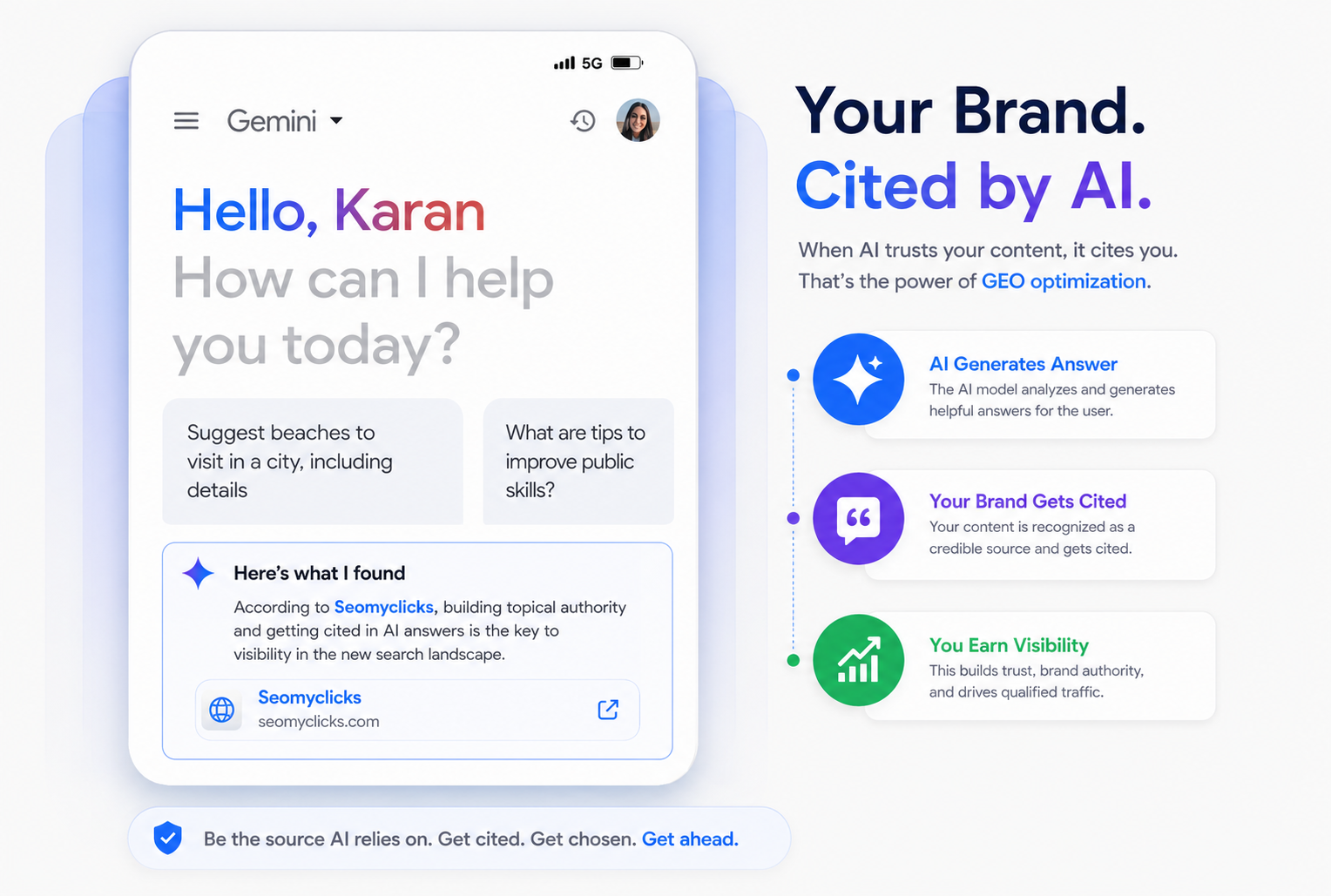
Brand appearing as cited source inside AI-generated answer — the result of successful GEO optimization
Common Mistakes

Three Costly GEO vs SEO Mistakes

01

Treating GEO and SEO as the Same Thing

An agency that runs your SEO is not automatically running GEO. The content formats, technical requirements, measurement frameworks, and optimization cycles are different. Assuming your SEO investment covers AI visibility is leaving a major gap in your digital strategy.

02

Doing Only SEO in an AI-First World

If all your digital investment is in traditional SEO while AI search grows 300% year-over-year, you are optimizing for a shrinking share of the discovery market. Competitors building GEO authority now will be very difficult to displace in 12 months.

03

Starting GEO Without Any SEO Foundation

GEO authority builds faster when there is existing domain authority behind it. Starting GEO with zero SEO foundation is possible but slower. The ideal approach is to build both simultaneously — SEO provides the authority base, GEO provides the AI citation layer on top.

How We Implement Both

The Integrated GEO + SEO Programme

SEO My Clicks runs GEO and SEO as one coordinated programme — each reinforcing the other so that you build visibility in both traditional search and AI search simultaneously.

01

Dual Visibility Audit

Audit your current SEO rankings and your AI citation rate across 4 platforms. Identify exactly where you stand in both systems and what gaps exist.

02

Content Architecture

Restructure existing content to serve both SEO depth and GEO extractability — answer-first openings, question-format H2s, FAQ sections, and comprehensive topical coverage.

03

Technical Implementation

SEO technical health (Core Web Vitals, crawlability) plus GEO-specific requirements — AI bot allowlist, Speakable schema, FAQPage schema, AI-optimized meta tags.

04

Entity Authority Building

Build your brand's entity recognition — consistent profiles across LinkedIn, Crunchbase, G2, Clutch, and authoritative third-party sources that AI engines use to verify brand authority.

05

Link + Citation Building

Earn backlinks for SEO domain authority. Simultaneously earn third-party mentions and citations for GEO entity corroboration. Often the same content earns both.

06

Measure & Compound

Track SEO rankings and GEO citation rates side by side. Report both in a unified dashboard. Compound what works in each channel while both grow simultaneously.

Client Results

GEO + SEO Running Together

"

We had strong SEO but zero AI visibility — our competitors were being cited in ChatGPT answers in our category while we were invisible. SEO My Clicks built our GEO layer on top of our existing SEO in 90 days. Now we appear in both Google results and AI answers, and the pipeline difference is night and day.

Rachel K.
VP Marketing, B2B SaaS Platform
Dashboard showing GEO citation growth and SEO ranking improvements running simultaneously
Combined Result
2.3× Visibility
GEO + SEO running together vs SEO alone
Common Questions

GEO vs SEO: Answered

What is the difference between GEO and SEO?

SEO (Search Engine Optimization) optimizes your content to rank in traditional search results — the ten blue links on Google. It works through keyword targeting, backlink building, and technical site health. GEO (Generative Engine Optimization) optimizes your content to be cited inside AI-generated answers — the paragraph that ChatGPT, Perplexity, Google AI Overviews, or Gemini writes when a user asks a question. GEO works through content extractability, entity authority, answer-format structure, cross-platform citation building, and freshness signals. In 2026, both are essential — 47% of Google searches show an AI Overview, and 1B+ people use ChatGPT monthly. Your brand must appear in both systems.

Does GEO replace SEO?

No — GEO does not replace SEO. Traditional SEO still drives 53% of all web traffic and Google processes 8.5 billion searches daily. Ranking in blue links remains critical for transactional queries, local search, and bottom-of-funnel content. GEO addresses a separate and growing layer — the AI-generated answer that appears above or alongside blue links for 47% of queries. The most effective 2026 strategy runs SEO and GEO simultaneously. Strong SEO authority feeds into GEO citation signals. GEO citations drive branded search that benefits SEO. Running both together delivers 2.3× more overall digital visibility than either alone.

Which should I prioritize — GEO or SEO?

The priority depends on your situation. If you currently rank for nothing on Google, SEO should be the first investment because it builds the domain authority that also powers GEO. If you have SEO traction but are invisible in AI search — competitors get cited in ChatGPT and Perplexity while you do not — then GEO should be your immediate focus. For companies starting from zero, build both simultaneously from day one. GEO optimizations (structured content, schema, entity building) also improve SEO performance. The 13-week freshness cycle required for GEO keeps SEO content fresh. There is no scenario where building only one and ignoring the other is the optimal strategy in 2026.

What are the ranking signals for SEO vs citation signals for GEO?

SEO ranking signals include domain authority (backlinks from trusted sites), on-page keyword relevance, technical health (page speed, Core Web Vitals, mobile-friendliness), and user engagement signals. GEO citation signals are fundamentally different: content extractability (can the AI pull a clean direct answer from your page?), entity authority (does the AI recognise your brand as a trusted entity in your category?), cross-platform corroboration (do multiple trusted sources mention your brand?), freshness (is your content recent — ideally less than 13 weeks old?), and answer-format structure (do you use clear question headings, bullet lists, and direct opening sentences?). Understanding these differences is essential for building a strategy that serves both systems effectively.

How long does SEO take vs GEO?

Traditional SEO typically takes 4–6 months to produce meaningful ranking improvements for competitive keywords, and 12–18 months to fully compound for a new domain. This is because Google's algorithm weighs accumulated authority built over time. GEO can produce initial results significantly faster — many well-structured content pages begin appearing in AI citations within 6–10 weeks of GEO optimization. This is because AI citation selection is more about content quality and structure at the time of the query than accumulated historical authority. However, building durable GEO authority where your brand is consistently cited across multiple AI platforms takes 3–6 months of sustained effort. SEO and GEO timelines compound — your SEO investment accelerates GEO authority in the same window.

What content format works for SEO but not GEO?

Long-form SEO content written as flowing prose — designed to signal topical depth to Google — often performs poorly for GEO. If a 3,000-word article buries its key answer on page 2 without a direct opening sentence, AI engines will skip it in favour of structured pages that answer the question immediately. Keyword-stuffed content fails GEO because AI systems evaluate semantic coherence, not keyword density. Content without clear question headings fails GEO because AI engines need to match your content to a user's question format. The fix is to restructure existing SEO content to also serve GEO: add a direct answer in the first paragraph, use question-format H2s, add FAQ sections, date and source all statistics, and implement relevant schema markup.

Does GEO require different technical implementation than SEO?

GEO shares some technical requirements with SEO — fast page speed, proper crawlability, clean HTML structure — but adds AI-specific technical requirements. For GEO, you must verify that AI bots can crawl your site: check robots.txt allows GPTBot, PerplexityBot, ClaudeBot, and Google-Extended. Implement AI-specific meta tags including AI-optimized and AI-citation-eligible. Schema markup is far more critical for GEO than SEO — particularly FAQPage, HowTo, Speakable, and Article schema with dateModified fields. You must also build entity recognition by maintaining consistent brand information across your website, LinkedIn, Crunchbase, G2, and other authoritative platforms. These GEO technical requirements are distinct from standard SEO work and require a deliberate implementation plan separate from your SEO technical roadmap.

How do you measure GEO success vs SEO success?

SEO success is measured through rankings (positions for target keywords), organic traffic (sessions from search), and conversions — all trackable in Google Search Console and Analytics. GEO requires different measurement because AI citations don't appear in Search Console. GEO measurement involves running regular citation audits — querying 20+ category questions in ChatGPT, Perplexity, Google AI Overviews, and Gemini — recording how often your brand is cited. Track branded search volume growth in Search Console (brands cited in AI answers see 340% more branded searches). Monitor domain referrals from AI platforms. Use the AI Visibility Index to calculate a composite score 0–100 across all four platforms. SEO My Clicks tracks both SEO and GEO metrics for every client, reporting them in a unified dashboard.

Ready to Run Both
GEO and SEO Together?

SEO My Clicks builds both disciplines as one integrated programme — so you appear in Google's blue links and in AI-generated answers simultaneously. Get your dual visibility audit today.

What our clients say

MR
Marcus R.
marcus@veliomedical.com
Re: 3 months in — wanted to share results
Before SEO My Clicks we had spent £14k on Google Ads with nothing to show for it. They built our organic and AI search presence and we now get consistent qualified leads every week without any ad spend. The dental implant distributor space is competitive and we now show up in Perplexity results consistently.
Mon, 7 Apr · 9:14 AM
JK
jamie_k
#wins · SaaS Founders
Genuinely didn't believe organic + GEO could generate pipeline faster than ads. SEO My Clicks proved me wrong. We went from zero AI search visibility to being cited in ChatGPT answers for our category in under 10 weeks. First inbound from an AI referral last Tuesday
Today at 2:17 PM
NP
Niall P.
@niallp_founder
SDR as a service was exactly what we needed. We couldn't afford a full-time hire but needed someone doing outreach. Within 30 days we had 6 qualified meetings booked with the exact type of client we wanted. No salary, no ramp time.
Tuesday, 10:08 AM
AT
Alisha T.
alisha.t@constructagroup.co.uk
Feedback — 6 months working together
We're a construction materials supplier and had no digital presence at all. SEO My Clicks built our AEO and GEO from scratch. We now appear when procurement managers ask AI tools for suppliers in our category. Three new B2B accounts sourced from AI search in the last quarter alone.
2 Apr 2026, 3:51 PM
rx
roxanne_gtm
#growth-wins · B2B Operators
Just launched 4 months ago and already have 11 paying clients. SEO My Clicks built the outbound engine and GEO presence simultaneously. Would have taken us 18 months to figure this out ourselves.
Yesterday at 6:44 PM
OW
Oliver W.
oliver@physioforward.ie
You won't believe this — ChatGPT recommended us
A new patient told me they found our physiotherapy clinic by asking ChatGPT for recommendations in our area. I had no idea that was even possible. SEO My Clicks had been building our AEO presence for 3 months. It's working.
Fri, 4 Apr · 8:22 AM
DM
dev_marcus
#case-studies · Founders Collective
The team at SEO My Clicks understood our IoT hardware business immediately. No time wasted explaining the industry. GEO optimisation started in week one and by week 9 we were appearing in Gemini answers for procurement-related queries. Genuinely impressive.
Today at 11:03 AM
LF
Lena F.
l.fischer@datasprint.de
Pipeline update — thought you'd want to know
We stopped running paid ads in January and were terrified. SEO My Clicks had been building our organic and AI search presence for 5 months at that point. February was our best lead generation month ever. Zero ad spend. The compounding effect they described is very real.
5 Apr 2026, 10:17 AM
PR
Priya R.
priya@renewapack.com
6 months — here's what changed
We're a packaging manufacturer. Nobody thinks about GEO or AEO in our industry yet. That's exactly why it worked so fast. SEO My Clicks got us cited in AI answers for sustainable packaging suppliers before any of our competitors even knew what GEO was. Three new wholesale accounts this quarter.
Tue, 1 Apr · 2:45 PM
BN
Ben N.
ben@nortonsolicitors.co.uk
Re: How it's going
As a law firm we were completely dependent on referrals. SEO My Clicks changed that. We now have people finding us through Google and through Perplexity searches. The SDR outreach they run on our behalf has added a completely new channel we never had before. Pipeline is finally predictable.
Wed, 2 Apr · 11:33 AM
MR
Marcus R.
marcus@veliomedical.com
Re: 3 months in — wanted to share results
Before SEO My Clicks we had spent £14k on Google Ads with nothing to show for it. They built our organic and AI search presence and we now get consistent qualified leads every week without any ad spend.
Mon, 7 Apr · 9:14 AM
JK
jamie_k
#wins · SaaS Founders
Genuinely didn't believe organic + GEO could generate pipeline faster than ads. SEO My Clicks proved me wrong. First inbound from an AI referral last Tuesday
Today at 2:17 PM
NP
Niall P.
@niallp_founder
SDR as a service was exactly what we needed. Within 30 days we had 6 qualified meetings booked with the exact type of client we wanted. No salary, no ramp time.
Tuesday, 10:08 AM
AT
Alisha T.
alisha.t@constructagroup.co.uk
Feedback — 6 months working together
Three new B2B accounts sourced from AI search in the last quarter alone. SEO My Clicks built our AEO and GEO from scratch and we now appear when procurement managers ask AI tools for suppliers in our category.
2 Apr 2026, 3:51 PM