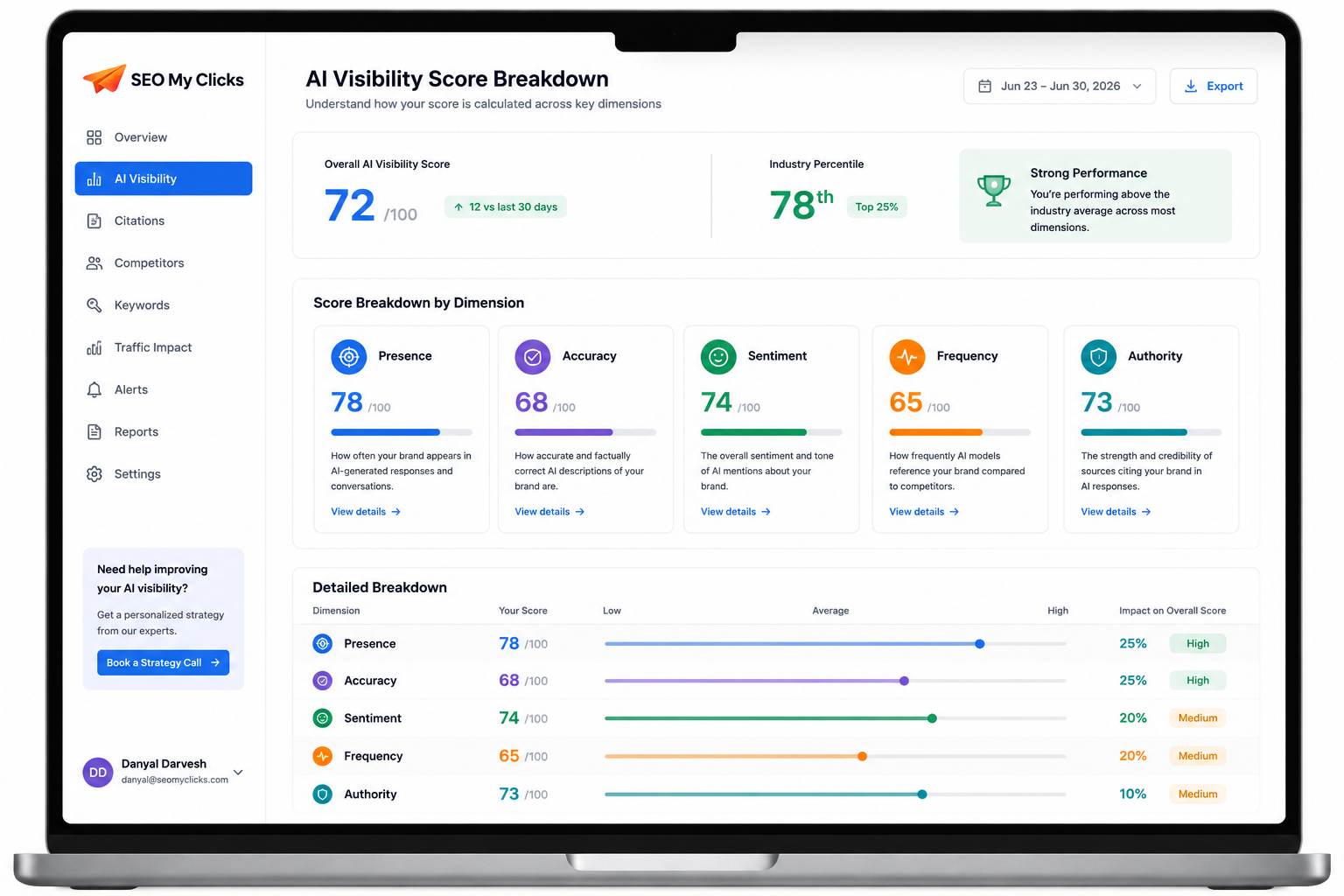
The SEO My Clicks AI Visibility Index measures how prominently your brand appears in ChatGPT, Perplexity, Google AI Overviews, and Gemini — on a single 0–100 score. 83% of companies don't know their number.
The AI Visibility Index translates your brand's footprint across four AI platforms into a single measurable number — giving you a baseline, a benchmark, and a roadmap.
Measures how frequently and accurately your brand appears in ChatGPT responses across branded and category-level queries in your vertical.
Tracks how often Perplexity cites your brand as a source, and whether citations are primary, secondary, or absent across topic clusters.
Monitors what percentage of relevant AI Overview queries include your brand or content as a sourced answer within the SERP.
Evaluates brand visibility in Google Gemini responses, which are increasingly integrated into enterprise Google Workspace environments.
The index spans 4 AI platforms — ChatGPT, Perplexity, Google AI Overviews, and Gemini — and evaluates 5 dimensions per platform. Each dimension is scored 0–25 and aggregated into a single composite score from 0 to 100.
Measures your brand's presence in ChatGPT answers across 20 branded and category queries in your vertical. Scored on presence, accuracy, and sentiment.
Tracks citation frequency and citation tier (primary vs. secondary) when Perplexity generates answers in your category. Higher citation tier = more score.
Measures what percentage of relevant AI Overview queries include your brand or content as a sourced answer, and whether you appear above or below the fold.
Evaluates brand presence in Google Gemini responses across product, category, and comparison queries. Especially critical for enterprise B2B brands.
Measures how thoroughly AI engines "know" your brand — evaluating whether key facts, products, executives, and differentiators are consistently represented.
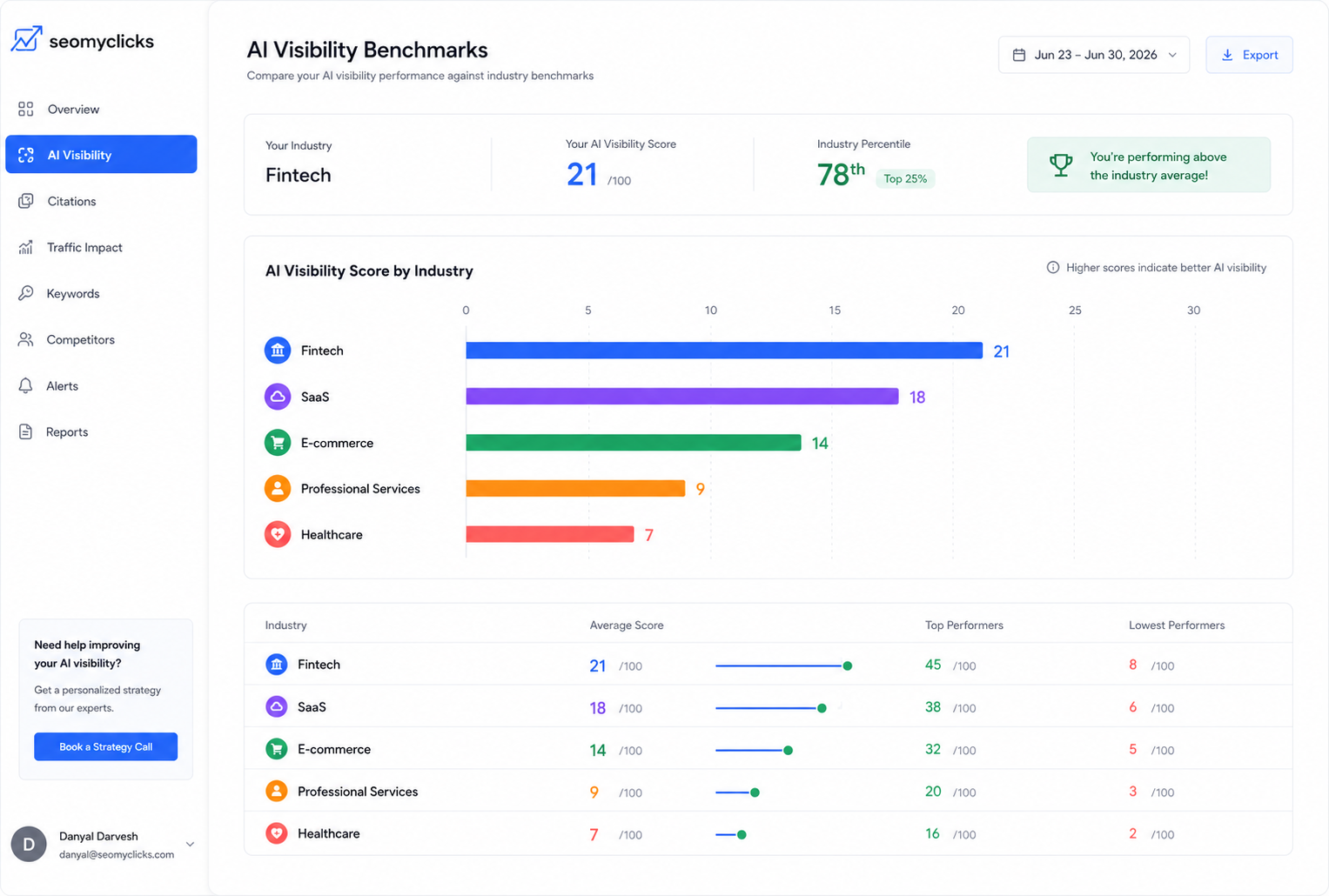
Compare your score to sector averages: SaaS avg 18, E-commerce avg 14, Fintech avg 21, Professional Services avg 9, Healthcare avg 7.
Each platform is audited using 40 total queries — 20 branded and 20 category-level. Results are scored across five dimensions to produce a platform sub-score, which is then aggregated into the composite AI Visibility Index.
Does your brand name appear in the AI-generated answer at all?
Is the information about your brand factually correct and up to date?
Is the framing of your brand positive, neutral, or negative in context?
How consistently does your brand appear across repeated queries over time?
Are you cited as a primary source or merely mentioned in passing?
Most industries are severely under-indexed for AI visibility. Here are current average scores by sector — and what the top performers in each vertical have achieved.
| Industry | Avg Score | Top 10% |
|---|---|---|
| Fintech | 21 | |
| SaaS | 18 | |
| E-commerce | 14 | |
| Prof. Services | 9 | |
| Healthcare | 7 |
Track your composite AI Visibility Score and per-platform breakdown in real time. Available as a dashboard and mobile score tracker.
These three assumptions are costing brands AI-driven pipeline without them knowing it.
Most brands assume their SEO presence translates directly to AI visibility. It often does not. 83% of companies have never audited their AI Visibility Score, meaning they are investing in GEO and AEO without a baseline to measure against.
Starting a GEO or AEO program without an AI Visibility Score is like running a performance marketing campaign with no conversion tracking. You cannot demonstrate ROI, identify what is working, or prioritize the highest-impact improvements.
Organic traffic is a lagging indicator of AI search performance. By the time traffic drops because AI engines are bypassing your content, the competitive gap has already widened. The AI Visibility Score is a leading indicator that gives you early warning.
A rigorous 6-step process ensures your score is accurate, reproducible, and benchmarkable against your industry peers.
Run a standardized set of 20 branded and 20 category-level queries across ChatGPT, Perplexity, Google AI Overviews, and Gemini. Document every instance of brand appearance, citation, and exclusion.
Evaluate each of the five dimensions (Presence, Accuracy, Sentiment, Frequency, Authority) per platform. Each dimension contributes to the platform sub-score on a 0–25 scale.
Aggregate the four platform sub-scores into a weighted composite AI Visibility Score between 0 and 100. Platform weighting is calibrated based on your specific buyer persona's AI usage patterns.
Compare your composite score and individual platform sub-scores to sector-specific benchmarks. Identify whether you are above, at, or below your industry average and by how much.
Target the weakest dimension and lowest-scoring platform first. Build a prioritized roadmap of GEO and AEO interventions with projected score improvements and timeline estimates for each action.
Repeat the full audit every 30 days to track score changes, validate improvement from GEO and AEO work, detect model update impacts, and report progress to stakeholders with clear trend data.
We had no idea our AI visibility score was 6/100. Within 90 days of working with SEO My Clicks it was 41. That directly correlated with a 280% increase in branded search.
The AI Visibility Index is a proprietary scoring framework developed by SEO My Clicks that measures how prominently and frequently your brand appears in answers generated by AI platforms including ChatGPT, Perplexity, Google AI Overviews, and Gemini. It produces a composite score from 0 to 100 based on five dimensions: Presence, Accuracy, Sentiment, Frequency, and Authority. The index gives brands a measurable baseline for their generative engine optimization efforts and allows for benchmarking against industry peers. Unlike traditional SEO metrics that measure clicks and rankings, the AI Visibility Index captures a brand's footprint in the AI-generated answer layer that is increasingly the first touchpoint for high-intent B2B buyers.
The AI Visibility Score is calculated by running a standardized set of 20 branded queries and 20 category-level queries across four AI platforms: ChatGPT, Perplexity, Google AI Overviews, and Gemini. Each platform is scored on five dimensions — Presence, Accuracy, Sentiment, Frequency, and Authority — each worth up to 5 points. Each platform dimension total is then aggregated into a platform sub-score of 0–25, and the composite score is the weighted average across all four platforms. The result is a single AI Visibility Score between 0 and 100 representing your brand's current footprint in AI-generated answers.
The average AI Visibility Score across all brands we have measured is 12 out of 100, which reflects how early most brands are in optimizing for AI search. A score above 25 places a brand in the top quartile. A score above 40 places a brand in the top 10%, and brands at this level see on average three times more inbound leads attributed to AI-driven discovery. For B2B SaaS companies, a score above 30 is considered strong. Professional services firms typically score below 15 unless they have invested specifically in GEO and AEO. The index is relative to your industry, so we always benchmark your score against sector-specific averages before making improvement recommendations.
We recommend measuring your AI Visibility Score every 30 days at minimum. AI platforms update their underlying models, retrieval systems, and citation algorithms frequently — sometimes multiple times per month. A monthly measurement cadence allows you to catch score drops caused by model updates, detect improvements from GEO and AEO work, and build a trend line that shows momentum over time. Brands in highly competitive categories or those actively running AI visibility improvement campaigns may benefit from bi-weekly measurement. Annual or quarterly measurement is insufficient given how rapidly the AI search landscape is evolving in 2026.
Platform importance varies significantly by industry and use case. For B2B technology buyers, ChatGPT and Perplexity tend to be the highest-impact platforms because these audiences actively use AI assistants for vendor research and competitive comparisons. For healthcare and professional services, Google AI Overviews may carry more weight because queries often begin in Google Search before surfacing an AI-generated summary. Gemini is gaining ground rapidly in enterprise contexts due to its integration with Google Workspace. We assess platform weighting for each client based on their specific buyer persona and documented research behaviors.
Most clients begin seeing measurable score improvements within 45 to 60 days of beginning a structured GEO and AEO program. The speed of improvement depends on starting score, content publishing velocity, the authority of third-party sources that reference your brand, and the competitive intensity of your category. Brands with existing domain authority and a content library tend to improve faster because we can optimize and restructure existing assets rather than building from zero. In our broader client portfolio, the average improvement in the first 90 days is 22 points, with compounding gains in months four through six as citation signals accumulate.
Yes. AI visibility is not exclusively determined by brand size or domain authority. AI engines frequently cite niche-specific, highly authoritative content from smaller publishers over generic content from large brands. A small professional services firm that publishes deeply specific, well-structured content in its vertical can achieve AI visibility scores well above the industry average. The AI Visibility Index actually creates an opportunity for smaller brands to compete with enterprise competitors on a more level playing field than traditional SEO, because AI engines reward relevance, structure, and specificity rather than raw link authority alone.
AI visibility and traditional SEO are complementary but distinct disciplines. Traditional SEO optimizes for ranking positions in the ten blue links and drives traffic through clicks. AI visibility optimizes for citation and mention within AI-generated answers, where the goal is not always a click but brand awareness, authority signaling, and top-of-funnel influence. Brands with strong traditional SEO foundations typically start with higher AI Visibility Scores because AI engines pull from web content and tend to favor established, well-linked sources. However, a high domain authority does not guarantee AI citation, and many high-DA brands have very low AI Visibility Scores because their content is not structured in the formats AI engines prefer.
Join the brands that know exactly where they stand in AI search — and have a roadmap to improve it. Measurement takes 5 business days. Benchmarks and improvement roadmap included.
What our clients say