The distinction between AI search and traditional search is not about the interface — it is about the fundamental mechanism by which each system connects users with information. Understanding this distinction is the prerequisite to optimizing your business's visibility in either channel.
Traditional Search: The Link Directory Model
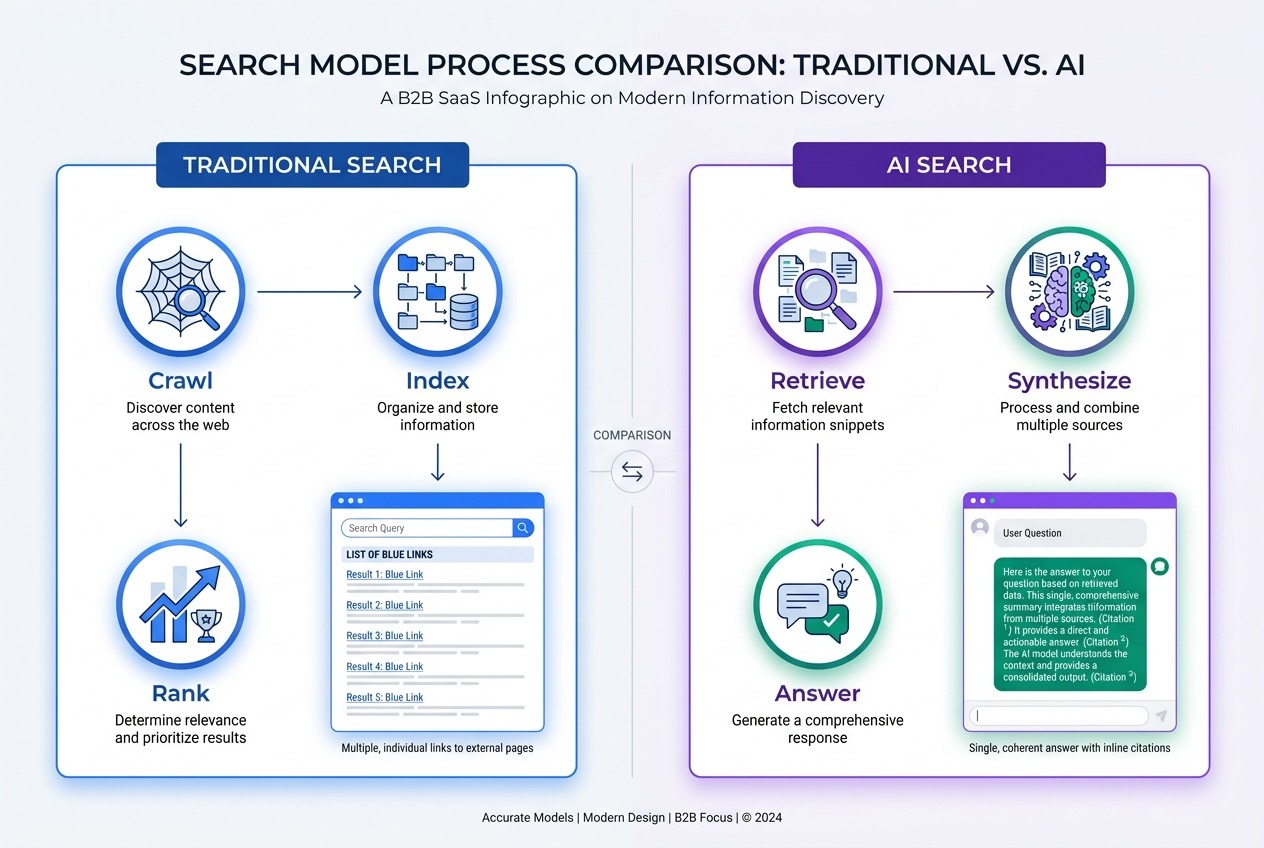
Traditional search engines like Google (in its classic form) operate as sophisticated link directories. A crawler visits web pages, reads and indexes their content, and builds a massive database of page-to-content relationships. When a user enters a query, the search engine retrieves the most relevant pages from its index based on hundreds of ranking signals — keyword relevance, page authority derived from backlinks, user engagement metrics, page experience factors, content freshness, and more.
The output is a ranked list of links. The user reads the titles and meta descriptions, clicks the most promising result, reads the webpage, and either finds their answer or returns to try another link. Value creation depends entirely on the click.
AI Search: The Synthesis Model
AI search engines — including ChatGPT Search, Perplexity, Gemini, and Google's own AI Overviews — operate on a fundamentally different model. Rather than returning a list of links, they use large language models to synthesize information from multiple sources into a single, coherent, conversational answer.
The AI reads multiple relevant sources, identifies the common thread of accurate information, reconciles contradictions, and produces a natural-language response that directly answers the user's question. Source citations appear as footnotes or inline references — but the user's answer is in the AI's synthesis, not in the source documents. The user rarely needs to click.
The Ranking Signal Revolution
What makes a webpage rank in traditional search versus what makes it get cited in AI answers are fundamentally different signals. Traditional search rewards keyword optimization, link authority, technical performance, and engagement metrics. AI citation rewards content extractability (how clearly the answer is stated), entity authority (how established the brand is in trusted knowledge graphs), answer format quality (direct, concise, factual writing), content freshness (50% of AI-cited content is less than 13 weeks old), and third-party citation frequency (how often authoritative external sources mention your brand).
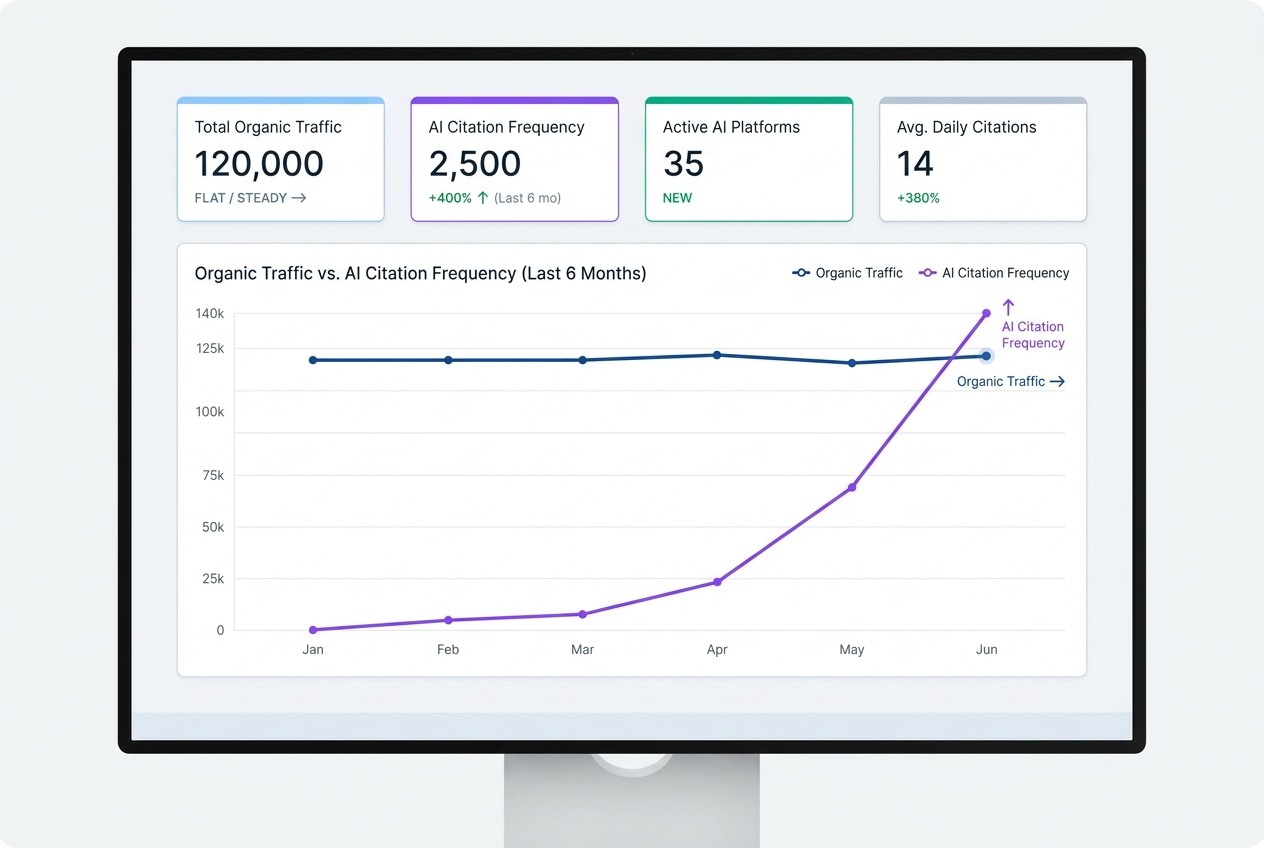
A page can rank in position 1 on Google and never appear in an AI Overview citation. A page can be frequently cited in AI answers while ranking on page 3 of traditional results. The two visibility systems are partially correlated but far from identical.
The Session Behavior Difference
AI search sessions are 4.2x longer than traditional search sessions in terms of time-on-search-interface. Users engage in multi-turn conversations with AI search tools, asking follow-up questions, seeking clarification, and exploring tangential topics — all without leaving the AI interface. This deeper engagement makes AI search a powerful research tool that users return to repeatedly for complex questions, while traditional search remains dominant for quick navigational and transactional queries.
Why You Need Both
The 65% of informational queries that now show AI results represent massive brand awareness opportunity — if your business is cited. The transactional and navigational queries that still drive clicks to organic results represent immediate revenue opportunity — if you rank. Neither channel alone captures the full potential of search visibility. The businesses that will dominate search in 2026 and beyond are those building parallel capabilities in traditional SEO and AI citation optimization (GEO/AEO) simultaneously.