What We Do
Who We Work With
Product Companies
Medical Device Manufacturers Dental Implant Suppliers Surgical Equipment Companies Supplement & Nutraceutical Brands Pharmaceutical Wholesalers Diagnostic Equipment Makers Industrial Machinery Manufacturers Safety Equipment Suppliers Packaging Manufacturers Chemical & Materials Suppliers Construction Materials Companies HVAC Equipment Suppliers IoT & Hardware Manufacturers Networking Equipment Suppliers Robotics & Automation Companies Security Hardware Manufacturers AgriTech Product Companies Renewable Energy Equipment Fashion & Apparel Wholesale Food & Beverage B2B Distribution Cosmetics & Beauty Wholesale Office Equipment & Supplies
Service Businesses
IT & Managed Service Providers Cybersecurity Firms Software Development Studios Cloud Solution Providers Data Analytics Consultancies AI Implementation Firms Management Consultancies HR & Recruitment Agencies Executive Search Firms Business Coaches & Advisors Training & Development Companies PR & Communications Firms Law Firms & Solicitors Accountancy Practices Financial Advisors & Planners Mortgage & Insurance Brokers M&A Advisory Firms Architecture Firms Interior Design Studios Structural Engineering Firms Facilities Management Companies Freight & Logistics Companies
Practitioners & Clinics
Dentists & Dental Clinics Therapists & Counsellors Psychologists & Psychiatrists Cosmetic Surgeons & Clinics Physiotherapists & Chiropractors Nutritionists & Dietitians Fertility Clinics Optometrists & Eye Clinics Hearing Care Specialists Specialist Medical Practices
Growth-Stage & Funded
SaaS & Software Companies Fintech & Financial Services HealthTech & MedTech EdTech & Online Learning PropTech & Real Estate Tech LegalTech Platforms Supply Chain & LogisticsTech Recruitment & HRTech Video Production Companies Branding & Creative Agencies Corporate Catering & Events Corporate Travel Management
How It Works
Resources
Contact Get a Growth Audit →
AEO Content Framework

The AEO Content Framework

Stop writing for humans to read and start writing for AI engines to extract. The DEEP content model is the systematic approach to structuring content that consistently wins featured snippets, AI Overviews, and AI engine citations.

More AI Citations after DEEP restructuring
67%
More Featured Snippets captured
2.4×
More Organic Leads from AI-referred traffic
The Core Methodology

The DEEP Content Model — Four Dimensions of AEO Content

Every piece of content that earns an AI citation shares four structural properties. The DEEP model names and operationalizes them — turning the difference between cited and ignored content into a repeatable system.

DEEP stands for Direct, Extractable, Evidenced, and Periodically Updated. Each dimension is a distinct structural requirement. Content that satisfies all four consistently outperforms content that satisfies none by a factor of four in AI citation rate, based on SEO My Clicks analysis of 1,200 pages across 40 client accounts (2026).

D — Direct
Lead With the Answer, Not the Context

AI engines read from the top of the page, extract the first clean answer they find, and stop. Content that opens with context, history, or narrative before reaching the answer loses the citation — not because the answer is wrong, but because it arrived too late.

Traditional / SEO Writing
"Search engine optimization has been around for 25 years and involves many complex factors including keywords, backlinks, and technical health. In this article, we'll explore what SEO is."
AEO / DEEP Writing
"SEO (Search Engine Optimization) is the practice of optimizing web pages to rank higher in Google search results by improving keyword relevance, backlink authority, and technical health."

The answer appears in sentence 1, not paragraph 4. Word count for the Direct opening: 40–60 words for the primary answer statement. Everything after that supports and expands — but the extractable core is already delivered in full.

E — Extractable
Structure for Machine Reading

AI engines process content differently from human readers. They parse HTML structure, identify heading hierarchy, and extract content from clearly delineated sections. Flowing prose without structural markers is the lowest-extractability format available.

Extractable content uses:

  • H2 headings phrased as questions, not creative titles
  • H3 sub-sections for specific aspects of each question
  • Bulleted or numbered lists for all multi-item content
  • Definition boxes for key terms and concepts
  • Summary boxes at the top of long-form pages
  • Tables for all comparison content
  • FAQ sections at the bottom of every page

Every long prose paragraph should ask: can this be restructured as a list, table, or Q&A? If the answer is yes, restructure it.

E — Evidenced
Back Every Claim With Data, Date, and Source

AI engines that retrieve and cite content also perform implicit factual verification. Content with unsourced statistics, vague claims, or outdated figures is deprioritized in favor of content with specific, attributable, dated facts.

Every statistic should follow this format:

Unverifiable Claim
"Many businesses struggle with AI visibility and don't know how they appear in AI answers."
Evidenced Claim
"83% of B2B companies do not know their AI visibility score, according to SEO My Clicks research (2026)."

Evidence quality and specificity are what separates citeable content from unverified opinion. Vague language — "many," "often," "most" — signals low-confidence content to both AI engines and readers.

P — Periodically Updated
The 13-Week Freshness Rule

50% of content cited by AI engines is less than 13 weeks old. AI engines treat content freshness as a quality signal — more recently updated content is presumed to be more currently accurate. This is not a coincidence or quirk; it is a built-in retrieval preference.

Periodic updating does not mean writing new articles on a 13-week cycle. It means:

  • Updating statistics to the most recent available figures
  • Adding new examples or case studies as they occur
  • Revising any claims that have become outdated
  • Updating the dateModified field in Article schema
  • Making the update date visible on the page
  • Ensuring time-sensitive content reflects current state

A 3-year-old article refreshed 8 weeks ago competes on freshness terms with content published 6 weeks ago. Refresh cycles are the minimum maintenance cost of sustained AI visibility.

Framework at a Glance

Everything You Need to Win AI Citations

The DEEP Model
Four Dimensions. One Systematic Framework.

Every dimension has a specific structural requirement and a specific implementation method. Miss one and citation probability drops. Hit all four and you outperform ungated content consistently.

D — Direct
Answer in sentence 1. 40–60 words maximum for the primary answer statement.
E — Extractable
Question H2s, bullet lists, definition boxes, FAQ sections, summary boxes.
E — Evidenced
[Number]% of [who] [what] — [Source] ([Year]). Every claim needs this format.
P — Periodically Updated
13-week freshness cycle. dateModified schema. Visible update date on page.
Dimension D
Direct Answer Opening
  • Answer appears in sentence 1, not paragraph 3
  • 40–60 words for the primary answer statement
  • No preamble, context, or narrative before the answer
  • Everything after sentence 1 supports and expands
D
Dimension E
Extractable Structure
  • H2 headings phrased as questions
  • Bullet lists for multi-item content
  • Definition boxes for key terms
  • Tables for comparisons
  • FAQ section on every page
E
Dimension E
Evidence Format

Every statistic follows one format:

[Number]% of [who] [what] — [Source] ([Year])

Not vague claims. Specific, attributable, dated facts only.

E
Dimension P
13-Week Freshness Rule
  • 50% of AI-cited content is under 13 weeks old
  • Refresh cycle: update stats, examples, claims
  • Update dateModified in Article schema
  • Make update date visible on page
P
Methodology
Question Clustering
  • WHAT — definitions and overviews
  • HOW — processes and implementation
  • WHY — business case and motivation
  • WHEN — timing and strategy
  • WHO — audience and providers
3–5 articles per topic minimum
Template
Answer Architecture
  • Q → Direct Answer (40–60 words)
  • Supporting Evidence (cited stats)
  • Examples and Case Data
  • Related Questions (H3s)
  • FAQ Schema at bottom
Repeat for each H2 section
Scoring Rubric
AEO Content Score
  • Question Alignment — /10
  • Answer Directness — /10
  • Extractability — /10
  • Evidence Quality — /10
  • Freshness — /10
  • Schema Completeness — /10
Target: 50+ / 60
Question Clustering Methodology

The Question Clustering Methodology

Every piece of content should be mapped to one of five question types. AI engines receive questions from users — your content must be structured as answers to questions. For each core topic your business covers, you need a minimum of 3–5 articles covering different question types. This creates a question cluster that signals topic authority and maximizes the query types for which AI engines can cite your content.

WHAT
Definitions & Overviews
"What is GEO?" "What is AEO content?" "What does DEEP stand for?"
HOW
Processes & Implementation
"How does GEO work?" "How do I structure AEO content?" "How do I measure AI visibility?"
WHY
Reasons & Motivation
"Why does GEO matter?" "Why is content freshness a ranking signal?" "Why aren't we in AI answers?"
WHEN
Timing & Strategy
"When should I start GEO?" "When do I refresh content?" "When does AEO start producing results?"
WHO
Audience & Providers
"Who needs GEO optimization?" "Who provides AEO services?" "Who is responsible for AI visibility?"
5 × 3
Five question types times three core topics equals 15 content assets — each covering a different AI query type
Topic clusters are 3× more likely to be cited than isolated articles on the same subject, per SEO My Clicks analysis (2026)
AEO Content Scoring Rubric

Score Your Content Before You Publish

Rate each piece of content 0–10 on 6 dimensions. Target score: 50+ / 60.

Dimension 0–3 Poor 4–7 Good 8–10 Excellent
Question Alignment Content about a topic — not structured to answer a specific question Answers a clear question but not in the most natural user phrasing Directly answers the exact query as users phrase it in AI engines
Answer Directness Answer buried after 2+ paragraphs of preamble or context Answer appears in paragraph 1 but not sentence 1 Clear direct answer in first 40–60 words with primary question answered immediately
Extractability Score Pure prose paragraphs, no structural elements or heading hierarchy Some headings and bullet lists present but not question-format Question-format H2s, bulleted lists, definition boxes, FAQ section, summary box
Evidence Quality Vague claims and qualitative language, no specific statistics or sources Some statistics present but missing source attribution or publication year Specific statistics with source and year, primary source links, case study examples
Freshness Over 6 months old with no visible update date on page Updated within 6 months, update date visible somewhere on page Updated within 13 weeks, dateModified in Article schema, specific update date prominent
Schema Completeness No schema markup of any kind Basic Article schema only, no FAQPage or Speakable markup Article + FAQPage + Speakable + HowTo (where applicable), all required fields complete
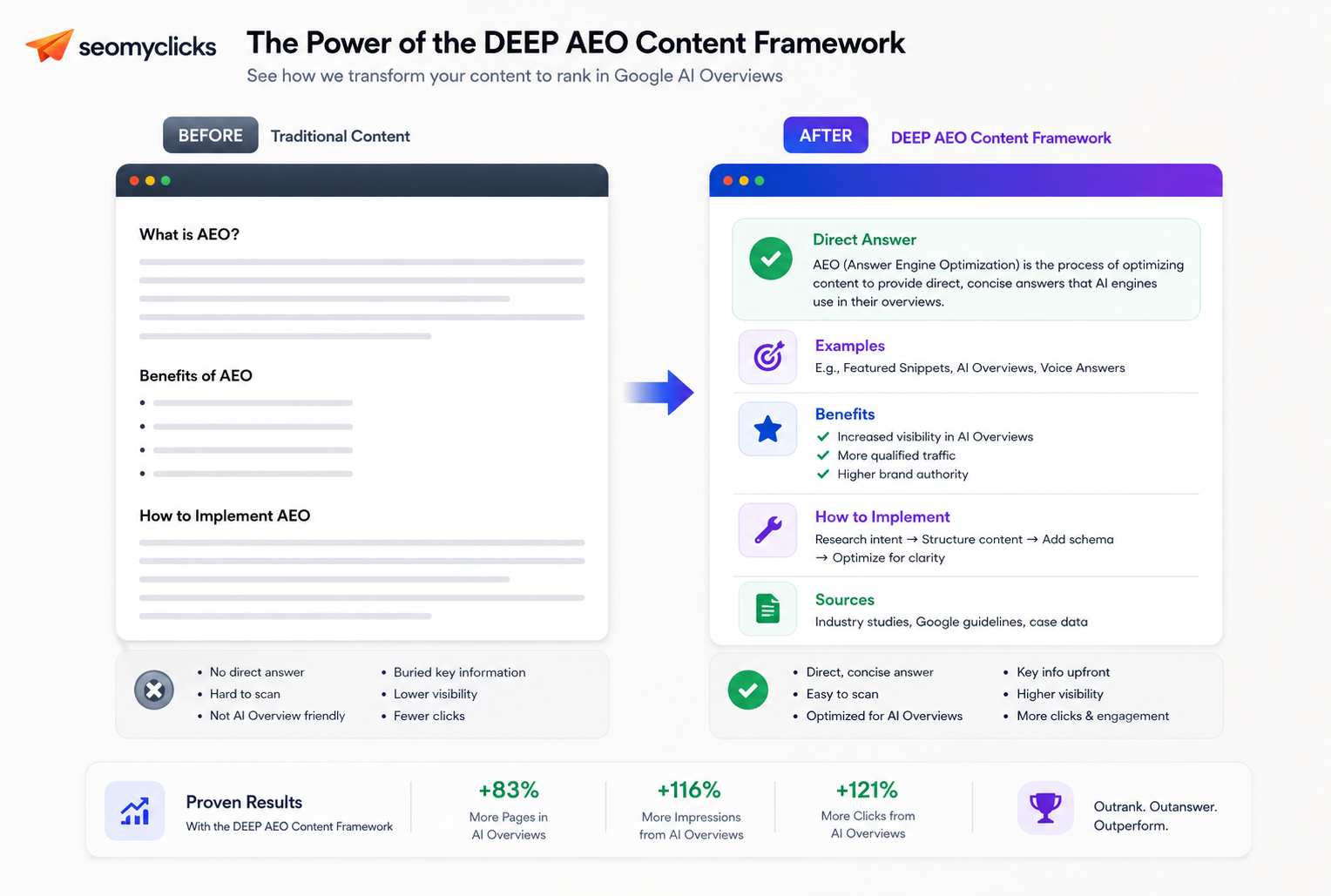
Before and after comparison showing the same content restructured with the DEEP AEO Content Framework
The DEEP Model Applied

Before and After: The DEEP Model Applied

The same information, restructured with DEEP methodology, consistently outperforms the original in AI citations. The key changes are simple: move the answer to sentence 1, add question-format H2 headings, convert prose lists to structured bullets, add specific dated statistics, and implement FAQ schema.

These structural changes — not the information itself — determine whether AI engines can extract and cite the content. The information was always there. The structure was preventing extraction.

Citation Rate
67%
More Snippets
45d
To First Result
See the Template

DEEP Structure Applied to Real Content

The DEEP framework applied to a live service page: direct opening answer, question-format headings, structured evidence, FAQ schema — all in one template that replicates across any topic or content type.

Request the Template
AEO Content Framework shown across laptop, tablet and phone
In Practice

Question Clustering in Practice

Most companies create content in isolation — one article about topic A, one about topic B, rarely thinking about the question types they're covering. Question clustering fills the gaps systematically.

For each topic your business owns, map your existing content to the five question types. Identify which types are missing. Create dedicated pages for the missing types. The result is a topic cluster where AI engines can cite your brand for WHAT questions AND HOW questions AND WHY questions — meaning more total citation opportunities across more query types.

  • WHAT pages — category education, definitions, overview explanations
  • HOW pages — implementation guides, process walkthroughs, step-by-step instructions
  • WHY pages — business case content, motivation, urgency explanations
  • WHEN pages — timing guidance, strategy calendars, readiness frameworks
  • WHO pages — audience definitions, provider comparisons, stakeholder mapping
5 × 3
Question types × core topics = 15 content assets minimum
Topic clusters more likely to be cited than isolated articles
Question Cluster Map
WHAT
Definition
HOW
Process
WHY
Business Case
WHEN
Timing
WHO — Audience & Providers
Common Blockers

Why Content Fails to Get Cited

Three structural mistakes account for the majority of AI citation failures. Each has a direct fix.

01
"We publish content but rarely appear in AI answers."

Content written as continuous prose without structural markers is the lowest-extractability format available. AI engines cannot pull clean answers from unbroken paragraphs — they need structural signals (question H2s, bullet lists, FAQ sections) to know where answers start and end. Prose-only content is invisible to extraction algorithms regardless of how good the information is.

02
"We start every article with context and history before the answer."

Traditional journalism structure kills AEO. AI engines read from the top, extract the first clean answer they find, and stop reading. If your answer is in paragraph 3, you need AI engines to read through paragraphs 1 and 2 of context first — and they don't. Restructure so the direct answer is in sentence 1, and everything after it is evidence and expansion.

03
"We update content every year or two."

13 weeks is the freshness threshold that matters for AI citation. Annual updates leave 39 weeks of citation underperformance between cycles. Quarterly refresh cycles are the minimum for sustained AI visibility — and refreshing means updating stats, examples, and the dateModified schema field, not rewriting the article from scratch.

Implementation

Six Steps to Implement the AEO Content Framework

A structured implementation sequence that produces first AI citation results within 30–45 days.

Step 01
Audit Existing Content

Score your top 20 pages against the 6-dimension rubric. Calculate each page's score out of 60. Pages scoring under 30/60 are priority rewrites — these have the most improvement potential and will produce the fastest measurable results.

Step 02
Identify Question Clusters

Map your core topics to the five question types (WHAT, HOW, WHY, WHEN, WHO). For each topic, identify which question type pages are missing from your current content library. Missing types are new content opportunities with direct citation potential.

Step 03
Restructure Priority Pages

Rewrite openings to lead with direct answers in the first 40–60 words. Convert prose lists to structured bullet points. Add question-format H2 headings. Add FAQ sections at the bottom of every priority page. Republish with updated modification dates.

Step 04
Build the Evidence Layer

Update all existing statistics to cited, dated sources using the [Number]% [who] [what] — [Source] ([Year]) format. Add case study examples where claims are currently unsupported by specific data. Replace vague qualitative language with specific quantitative evidence throughout.

Step 05
Implement Schema Stack

Add FAQPage schema to all FAQ sections. Implement Article schema with dateModified field. Add Speakable specification to key answer sections. Add HowTo schema to all process and implementation pages. Validate all schema using Google's Rich Results Test before republishing.

Step 06
Activate Freshness Calendar

Schedule 13-week refresh dates for all priority pages. Add these dates to your editorial calendar as hard deadlines, not suggestions. Update dateModified in Article schema on each refresh. Make the update date visible on every page. Track AI Overview appearances in Search Console against refresh cycles.

Client Results

DEEP in the Wild

"

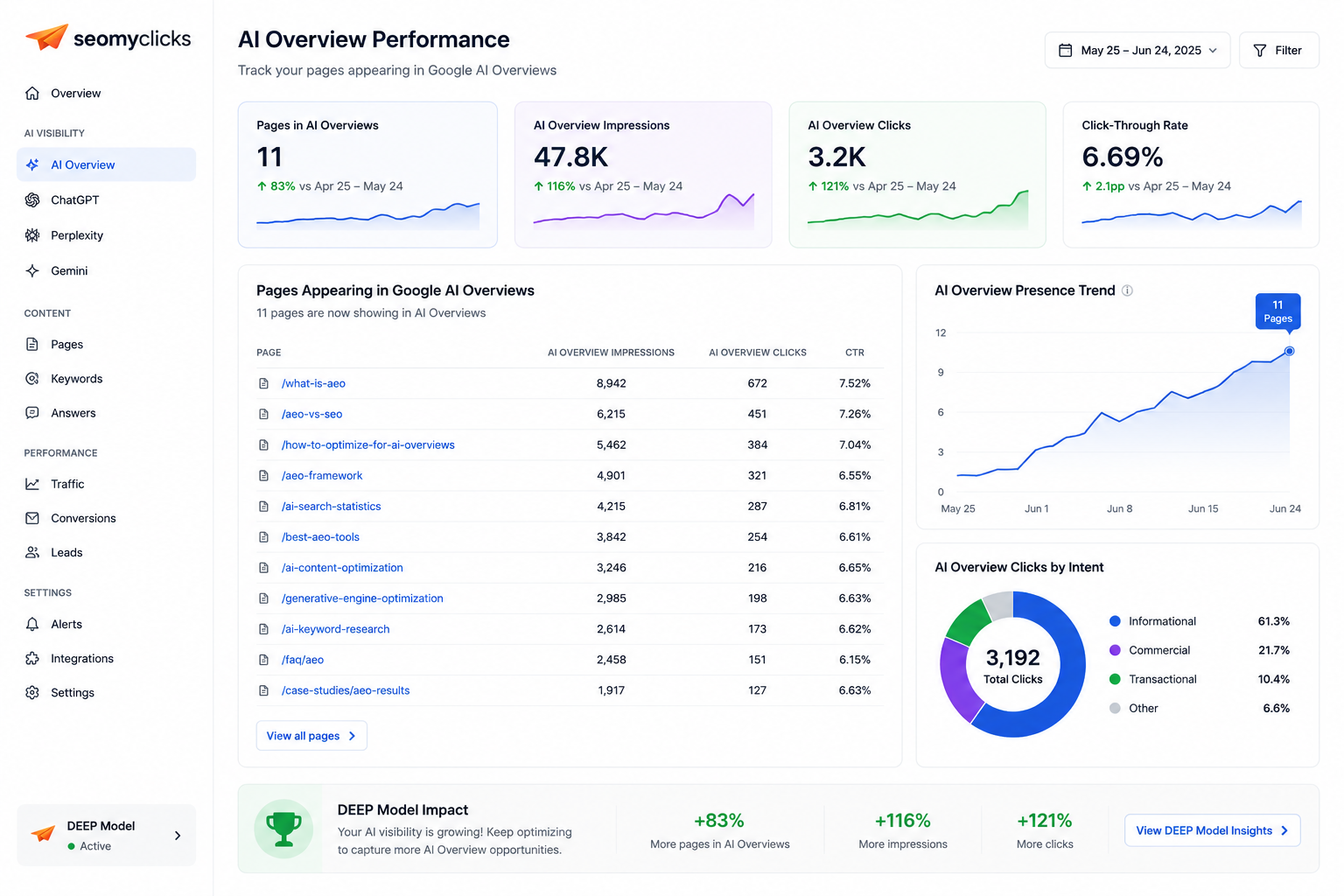
After restructuring our top 20 pages with the DEEP model, 11 of them started appearing in Google AI Overviews within 45 days. The change was simple — we just moved the answer to sentence 1 on every page and added FAQ sections. SEO My Clicks guided the entire restructure.

LP
Lena P.
Head of Content, B2B SaaS Platform
Analytics showing 11 pages appearing in Google AI Overviews after DEEP model implementation
11/20 Pages in AI Overviews
45 Days to First Result — after DEEP restructuring
Common Questions

Frequently Asked Questions

What is the AEO Content Framework?

The AEO Content Framework is SEO My Clicks' structured methodology for creating content that gets cited by AI engines including Google AI Overviews, ChatGPT, Perplexity, and Claude. It is built around the DEEP content model — four dimensions that determine whether AI engines can extract, trust, and cite a piece of content. The four dimensions are Direct (answer in sentence one), Extractable (structured for machine reading), Evidenced (claims backed by dated sources), and Periodically Updated (refreshed within 13 weeks). The framework also includes question clustering methodology and a 6-dimension content scoring rubric with a maximum score of 60 points.

What does DEEP stand for in AEO?

DEEP stands for Direct, Extractable, Evidenced, and Periodically Updated — the four dimensions of the SEO My Clicks AEO Content Framework. Direct means the primary answer to the content's question appears in the first 40–60 words of the page. Extractable means the content is structured with question-format H2 headings, bullet lists, definition boxes, and FAQ sections that AI engines can parse and pull clean answers from. Evidenced means every statistic includes a source and year. Periodically Updated means content is refreshed at minimum every 13 weeks to maintain freshness as an AI citation quality signal.

How is AEO content different from SEO content?

AEO content (Answer Engine Optimization) is structured for machine extraction, while SEO content is structured for human reading and keyword matching. Traditional SEO content often opens with context, history, or narrative before reaching the answer — a format that ranks well in traditional search but performs poorly in AI citation because AI engines extract the first clear answer they find and stop reading. AEO content inverts this structure: the direct answer comes first, supporting evidence follows, and the entire piece uses structural markers that AI engines parse efficiently. AEO content also requires explicit evidence formatting and 13-week freshness cycles that traditional SEO content rarely follows.

What is the most important element of AEO content?

The single most important element of AEO content is answer directness — specifically, whether the primary answer to the page's question appears in the first 40–60 words of the content. AI engines read from the top of the page, extract the first clean answer they find, and use it as the citation. Content that opens with context, narrative, or preamble before reaching the answer loses the citation to content that leads with the answer immediately. This single structural change — moving the answer to sentence one — is responsible for the majority of AI citation improvement seen in pages restructured with the DEEP content model.

How do you structure a Direct Answer opening?

A Direct Answer opening states the primary answer to the page's question in the first sentence, within 40–60 words total. The formula: [Term/concept] is [definition or answer], [supporting detail 1], [supporting detail 2]. For example, instead of "Search engine optimization has been around for 25 years and involves many factors," write "SEO (Search Engine Optimization) is the practice of optimizing web pages to rank higher in Google results by improving keyword relevance, backlink authority, and technical health." The answer is complete in one sentence. Everything after that sentence expands, evidences, and structures the topic — but the extractable core is already delivered in full.

What types of content get cited most in AI answers?

Content that gets cited most in AI answers shares five structural characteristics: it leads with a direct answer in the first 40–60 words; it uses question-format H2 headings that match natural query phrasing; it includes an FAQ section with schema markup; it contains specific, sourced, dated statistics rather than vague claims; and it has been updated within the past 13 weeks. Content types that perform best include definition pages (What is X), process pages (How does X work), and comparison pages (X vs Y). Pure prose articles without structural elements and unsourced opinion content are the least-cited formats in AI engine responses.

How long should AEO-optimized content be?

AEO-optimized content should be as long as the question requires — not longer. The DEEP framework does not specify a target word count because AI engines cite based on answer quality and structure, not length. Most AEO-optimized pages follow this structure: a 40–60 word direct answer opening, 400–800 words of evidenced supporting content organized under question-format H2 headings, a bullet-list or table section for multi-item content, and an FAQ section with 4–8 questions. Total length typically falls between 800 and 1,800 words. Content over 2,500 words on one question should be split into multiple question-cluster pages rather than consolidated into one long article.

How do you measure whether AEO content is working?

AEO content performance is measured through four primary signals: AI Overview appearances in Google Search Console (tracked via the AI Overviews filter in the Performance report), featured snippet capture rate (tracked in Search Console by pages appearing at position zero), direct brand mention tracking in AI engine responses (manually testing key queries in ChatGPT, Perplexity, and Claude), and the 6-dimension AEO Content Scoring Rubric score for each page (target: 50+/60). Secondary signals include organic click-through rate improvements from featured snippet captures and lead quality changes from AI-referred traffic. First measurable results typically appear within 30–45 days of DEEP restructuring being published and indexed.

Get Started

Start Writing Content That Gets Cited

The DEEP content model is the foundation of AI citation optimization. SEO My Clicks audits your existing content against the 6-dimension scoring rubric, restructures priority pages with DEEP methodology, and implements the complete schema stack — so your content starts winning AI citations within weeks.

Based in Miami, FL

What our clients say

MR
Marcus R.
marcus@veliomedical.com
Re: 3 months in — wanted to share results
Before SEO My Clicks we had spent £14k on Google Ads with nothing to show for it. They built our organic and AI search presence and we now get consistent qualified leads every week without any ad spend. The dental implant distributor space is competitive and we now show up in Perplexity results consistently.
Mon, 7 Apr · 9:14 AM
JK
jamie_k
#wins · SaaS Founders
Genuinely didn't believe organic + GEO could generate pipeline faster than ads. SEO My Clicks proved me wrong. We went from zero AI search visibility to being cited in ChatGPT answers for our category in under 10 weeks. First inbound from an AI referral last Tuesday
Today at 2:17 PM
NP
Niall P.
@niallp_founder
SDR as a service was exactly what we needed. We couldn't afford a full-time hire but needed someone doing outreach. Within 30 days we had 6 qualified meetings booked with the exact type of client we wanted. No salary, no ramp time.
Tuesday, 10:08 AM
AT
Alisha T.
alisha.t@constructagroup.co.uk
Feedback — 6 months working together
We're a construction materials supplier and had no digital presence at all. SEO My Clicks built our AEO and GEO from scratch. We now appear when procurement managers ask AI tools for suppliers in our category. Three new B2B accounts sourced from AI search in the last quarter alone.
2 Apr 2026, 3:51 PM
rx
roxanne_gtm
#growth-wins · B2B Operators
Just launched 4 months ago and already have 11 paying clients. SEO My Clicks built the outbound engine and GEO presence simultaneously. Would have taken us 18 months to figure this out ourselves.
Yesterday at 6:44 PM
OW
Oliver W.
oliver@physioforward.ie
You won't believe this — ChatGPT recommended us
A new patient told me they found our physiotherapy clinic by asking ChatGPT for recommendations in our area. I had no idea that was even possible. SEO My Clicks had been building our AEO presence for 3 months. It's working.
Fri, 4 Apr · 8:22 AM
DM
dev_marcus
#case-studies · Founders Collective
The team at SEO My Clicks understood our IoT hardware business immediately. No time wasted explaining the industry. GEO optimisation started in week one and by week 9 we were appearing in Gemini answers for procurement-related queries. Genuinely impressive.
Today at 11:03 AM
LF
Lena F.
l.fischer@datasprint.de
Pipeline update — thought you'd want to know
We stopped running paid ads in January and were terrified. SEO My Clicks had been building our organic and AI search presence for 5 months at that point. February was our best lead generation month ever. Zero ad spend. The compounding effect they described is very real.
5 Apr 2026, 10:17 AM
PR
Priya R.
priya@renewapack.com
6 months — here's what changed
We're a packaging manufacturer. Nobody thinks about GEO or AEO in our industry yet. That's exactly why it worked so fast. SEO My Clicks got us cited in AI answers for sustainable packaging suppliers before any of our competitors even knew what GEO was. Three new wholesale accounts this quarter.
Tue, 1 Apr · 2:45 PM
BN
Ben N.
ben@nortonsolicitors.co.uk
Re: How it's going
As a law firm we were completely dependent on referrals. SEO My Clicks changed that. We now have people finding us through Google and through Perplexity searches. The SDR outreach they run on our behalf has added a completely new channel we never had before. Pipeline is finally predictable.
Wed, 2 Apr · 11:33 AM
MR
Marcus R.
marcus@veliomedical.com
Re: 3 months in — wanted to share results
Before SEO My Clicks we had spent £14k on Google Ads with nothing to show for it. They built our organic and AI search presence and we now get consistent qualified leads every week without any ad spend.
Mon, 7 Apr · 9:14 AM
JK
jamie_k
#wins · SaaS Founders
Genuinely didn't believe organic + GEO could generate pipeline faster than ads. SEO My Clicks proved me wrong. First inbound from an AI referral last Tuesday
Today at 2:17 PM
NP
Niall P.
@niallp_founder
SDR as a service was exactly what we needed. Within 30 days we had 6 qualified meetings booked with the exact type of client we wanted. No salary, no ramp time.
Tuesday, 10:08 AM
AT
Alisha T.
alisha.t@constructagroup.co.uk
Feedback — 6 months working together
Three new B2B accounts sourced from AI search in the last quarter alone. SEO My Clicks built our AEO and GEO from scratch and we now appear when procurement managers ask AI tools for suppliers in our category.
2 Apr 2026, 3:51 PM